Trip overview
Ask someone who has been to Laos what they saw and the answer is usually one town, not a country. This itinerary pushes back against that: thirteen days by private car, working steadily downhill from the old royal capital in the north to a scatter of river islands close to Cambodia in the far south. There are no flights anywhere in this plan; every kilometre is covered by road, which means genuine time to watch a small, landlocked country shift character from region to region rather than glimpsing it between airport transfers.
Nights are spread out deliberately, two or more at most stops, and the drives in between are kept within reason rather than stacked into marathon days. It works well for anyone who has already done a faster loop through Vietnam, Thailand or Cambodia and wants a different kind of pace this time around: canoeing through a mountain, drinking coffee where it is grown, standing in front of a temple built before Angkor, instead of another beach chair. Aim for the November to February window, when the whole route runs driest and coolest, particularly through the cave systems and waterfalls in the middle stretch.
Trip highlights
- Three nights in Luang Prabang for its temples, the Pak Ou caves and a forest waterfall
- The scattered stone jars of Xieng Khuang, part of a UNESCO World Heritage site
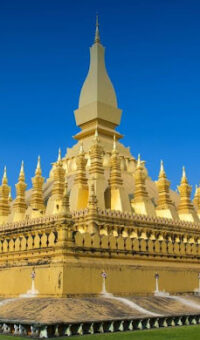
- A half-day tour of Vientiane’s landmarks, including That Luang and Wat Sisaket
- A canoe passage through the 7.5 km limestone tunnel of Khong Lor Cave
- Wat Phu, a pre-Angkorian temple ruin near Champasak with UNESCO status
- Khone Phapheng Falls and two nights on Don Khong among the Si Phan Don islands
Your day-by-day itinerary
Day 1: Arrive Luang Prabang
You land where a smaller river slides into the Mekong, in a town whose mix of French shopfronts and traditional wooden houses earned it UNESCO protection decades ago. Saffron robes, gilded rooflines and an easy pace by the water set the mood for what follows, and today carries no fixed plan at all, so settle in however suits you. If getting up before dawn appeals, ask your guide about the tak bat alms round tomorrow morning, watched from a respectful distance with your camera flash off, well away from the vendors who sell pre-packed sticky rice to tourists along the street.
Day 2: Luang Prabang city tour and Kuang Si Falls
A morning walk covers the old quarter properly: the former Royal Palace, Wat Xieng Thong’s distinctive low roof, a scatter of gilded temples and the town’s daily market. From there a short drive brings you to Kuang Si Falls, where the water steps down through a series of pale pools cool enough to swim in, with footpaths for anyone who would rather stay dry and simply look.
Day 3: Pak Ou Caves
Set into a limestone cliff where a tributary meets the Mekong, the Pak Ou caves are crowded with small Buddha statues by the thousand, a collection built up gradually by passing worshippers rather than staged for visitors. Getting there means a boat ride past forested banks and small riverside settlements, and that approach is worth just as much of your attention as the caves themselves once you arrive.
Day 4: Luang Prabang to Xieng Khuang
The road climbs south-east into Xieng Khuang province, home to the Plain of Jars, where enormous carved stone containers lie scattered across open ground for reasons archaeologists still argue over; UNESCO listed the site for exactly that unresolved mystery. This province also carries one of the heaviest bombing legacies of the Indochina war years, and unexploded ordnance remains a real hazard: every stop here keeps strictly to paths marked with the white and red stakes left by mine-clearance teams, with no exceptions.
Day 5: Xieng Khuang to Vang Vieng, city tour
Vang Vieng sits on the Nam Song, a Mekong tributary rather than the river itself, hemmed in on both sides by dramatic limestone peaks that have made it the country’s unofficial adventure-sports base: caves to duck into, rapids to kayak, flat lanes for cycling out to the villages nearby. Its town centre stays small enough to cover on foot, with a noticeably slower rhythm than either of the two capitals on this route.
Day 6: Vang Vieng to Vientiane, half-day city tour
A half-day is enough to cover Vientiane’s short list of major sites once you arrive: That Luang, a gold-covered stupa regarded as the country’s defining symbol; the Patuxay war memorial, often likened to a smaller, rougher Arc de Triomphe; Haw Phra Kaew, a former royal temple that briefly held the Emerald Buddha; and Wat Sisaket, the oldest temple standing in the capital, its cloister walls lined with thousands of small Buddha images.
Day 7: Vientiane to Ban Na Hin via Tha Khaek
South of the capital the road runs through Tha Khaek, a onetime French administrative outpost on the Mekong, before turning inland to Ban Na Hin, gateway to the Khong Lor cave system. Considerably fewer travellers make it this far than reach the well-worn northern circuit, and the pace here drops accordingly.
Day 8: Khong Lor Cave
A short drive from Ban Na Hin brings you to Khong Lor, a cave the Hinboun River has carved clean through a mountain over a 7.5 km stretch. A motorised canoe is how you cross it, gliding beneath ceilings that climb to 100 metres in places, past limestone shapes lit only by your own torch, with two waterfalls to break up the return trip.
Day 9: Ban Na Hin to Pakse via Savannakhet
A full day of driving carries you south through Savannakhet province to Pakse, southern Laos’s main crossroads town and, for generations, a trading link between Laos, Thailand and Vietnam alike. Lunch along the way is at your own cost, and the evening is free once you check into your Pakse hotel.
Day 10: Pakse to Don Khong via Wat Phu, Champasak
From Pakse the road drops to Champasak, home to Wat Phu, a stone temple complex predating Angkor by centuries and carrying its own separate UNESCO World Heritage listing, built against the foot of Phu Kao mountain roughly a thousand years ago. Few Khmer religious sites anywhere in Laos survive in this condition. From there the journey continues on to an overnight stay on Don Khong island.
Day 11: Don Khong and the Si Phan Don islands
The whole day belongs to Si Phan Don, the stretch near the Cambodian border where the Mekong splinters into hundreds of islands, sandbars and channels. Ban Khone still has its French colonial-era buildings and the country’s last surviving railway locomotive, and from there a tuk-tuk carries you to the Liphi rapids, also called Somphamit locally, plus Khone Phapheng Falls, generally reckoned Southeast Asia’s largest waterfall by sheer volume of water. What this stretch of river no longer has is Irrawaddy dolphins: the last one here died in February 2022, and the population is locally extinct, whatever older guidebooks or tour listings still claim. Kratie, over the border in Cambodia, is now the only realistic place left on the Mekong to see them, home to 117 dolphins as of April 2026.
Day 12: Don Khong to Pakse via Tadlo and the Bolaven Plateau
Returning north to Pakse, the road rises onto the Bolaven Plateau, several degrees cooler than the river valley below and known across Laos for the coffee, tea and cardamom grown on its slopes. Higher rainfall up here feeds a string of waterfalls near Tadlo, a last taste of rural southern Laos before the night back in Pakse.
Day 13: Departure
A transfer delivers you to Pakse International Airport for your onward or return flight, ending a trip that has run the full length of the country, from Luang Prabang’s temples in the north to the river islands of the deep south.
What’s included
- Hotels in the class you choose, twin or double occupancy, with breakfast each morning, or an equivalent property if the one named is full.
- All meals written into the day-by-day programme below.
- A private air-conditioned vehicle for every transfer and excursion in the programme.
- An English-speaking local guide at each stop on the route.
- Every boat trip, river crossing and cruise named in the itinerary.
- Entrance fees for the sites listed in the programme.
- Drinking water in the vehicle and on boat days.
- Government tax and service charge.
Not included
- International and domestic flights, and rail tickets.
- Visas, and any fee collected at a border post.
- Travel insurance.
- Meals and drinks that are not written into the programme.
- Personal spending such as laundry, phone calls, minibar, souvenirs and watersports.
- Early check-in, late check-out and room upgrades.
- Anything added on the day at your request outside the printed programme.
- Gratuities for your guide and driver.
- Costs arising from weather, flooding, road closures or other events beyond our control.
- Bank transfer charges.
Booking this trip
- Days
- 13 days / 12 nights
Sending this does not charge you. We hold the space and confirm within 24 hours.
For visas, payment terms and what to expect on arrival, see [Laos travel information](laos/travel-information).
Send us your travel dates and group size and we will confirm room availability the length of the route and hold your itinerary.