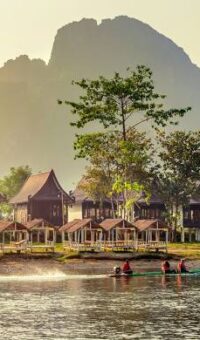
Getting to know Si Phan Don
South of Pakse, the Mekong widens out and breaks apart into what is usually translated as the Four Thousand Islands, a maze of sandbars, channels and permanent islands that runs almost to the Cambodian border. Only a handful of the islands are inhabited, and only two see any real number of visitors: Don Det and Don Khon, joined by an old French colonial bridge and reachable together on foot or by bicycle.
Don Det carries the region’s backpacker energy: bungalows on stilts, riverside bars, hammocks strung between posts, and a social, unhurried crowd. Don Khon, a short walk across the bridge, drops the volume considerably. Its French-era relics, a disused railway line and the remains of the bridge itself, are reminders of a colonial-era attempt to move river cargo around the rapids further south, and its guesthouses tend to draw travellers who came here specifically to slow down rather than to socialise.
This is not a polished destination, and it should not be sold as one. Electricity supply is patchy and air conditioning is rare outside the pricier guesthouses; bicycles and slow ferries are the normal way to get around rather than an activity in themselves. Travellers who come expecting a resort leave disappointed. Travellers who come expecting a few genuinely quiet days on the river tend to stay longer than they planned.
Things to see and do
Don Det
The livelier of the two main islands, with riverside guesthouses, bars and a backpacker crowd; the main base for most visitors.
Don Khon
Quieter and more spread out, reached on foot or by bicycle across the old French bridge from Don Det.
Khone Phapheng Falls
Often called the largest waterfall in Southeast Asia, though it is really a chain of rapids stretching more than 10 km. Reached from Nakasong by tuk-tuk or kayak.
Li Phi Falls
A narrower, more dramatic set of rapids on Don Khon, about a 25-minute walk or a 10-minute bicycle ride from the bridge connecting the two islands.
The old French railway and bridge
A short colonial-era line and its connecting bridge, built to haul river cargo around the rapids; the rusted relics remain on Don Khon.
Cycling the islands
Bicycles are the standard way to cover both islands, along dirt tracks that pass rice fields, small temples and riverside huts.
Good to know
| What | Detail |
|---|---|
| Getting there | Road from Pakse to Nakasong, then a short boat crossing to Don Det or Don Khon |
| Khone Phapheng Falls | A chain of rapids over 10 km long; reached from Nakasong by tuk-tuk or kayak |
| Li Phi Falls | About 25 minutes on foot, or 10 minutes by bicycle, from the Don Det–Don Khon bridge |
| Electricity and comfort | Patchy power supply, frequent outages, air conditioning limited to a handful of guesthouses |
| Getting around | Bicycles and slow local ferries; there are no paved roads connecting every point |
| Currency | Lao Kip (LAK) |
Trips that include Si Phan Don
Si Phan Don sits naturally at the southern end of a Laos route, and close enough to the Cambodian border to combine with Kratie or Phnom Penh for travellers heading further downriver. Tell us your pace, whether you want a couple of nights or a genuinely slow week, and we will plan around it.