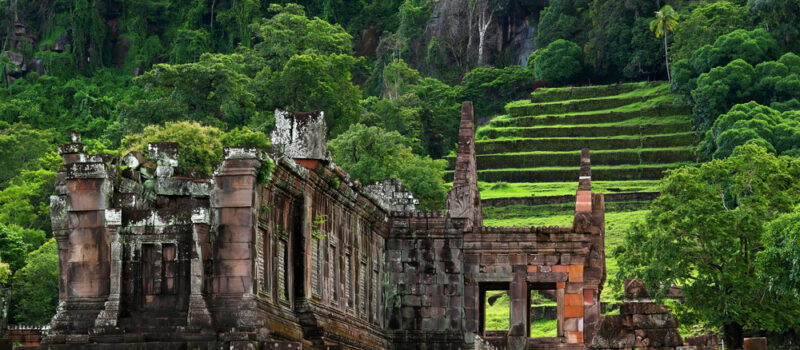
Getting to know Champasak and Pakse
Pakse sits at the point where the Se Don river runs into the Mekong, and it functions almost entirely as a gateway rather than a sightseeing stop in itself: an airport, a bridge over the Mekong, and roads leading out to everywhere travellers actually want to be in southern Laos. Most visitors spend one night here at either end of a trip, arriving or leaving by air, and treat the town itself as a base for what surrounds it.
An hour or so south of Pakse, the small riverside town of Champasak keeps a different rhythm. French colonial buildings line streets that see little traffic, a ferry still crosses the Mekong on demand, and the town’s main draw sits a short distance beyond it: Wat Phou, a temple complex built by the Khmer centuries before Angkor and recognised by UNESCO as a World Heritage Site in its own right.
East of Pakse, the land rises onto the Bolaven Plateau, cooler and greener than the river towns below it, where Lao coffee is grown and processed and a string of waterfalls, Tad Fane among them, breaks up the drive. Between Wat Phou, the plateau and Pakse’s role as the road south to Si Phan Don, this stretch of Laos rewards travellers who give it two or three days rather than a single overnight.
Things to see and do
Wat Phou
A Khmer temple complex at the foot of the sacred mountain Phu Kao, older than Angkor and built in the same architectural tradition; a UNESCO World Heritage Site.
Champasak town
A quiet, French colonial-era riverside town on the Mekong, with a small-town pace and an on-demand ferry across the river.
Bolaven Plateau coffee farms
Cooler highland country growing both arabica and robusta, with farms and roadside stalls open to visitors along the loop.
Tad Fane and the plateau waterfalls
Tad Fane and a scattering of smaller falls break up the drive around the Bolaven loop, usually covered over one to two days by car or motorbike.
Ethnic minority villages
Communities on the Bolaven Plateau, reached along the same loop road as the coffee farms and waterfalls.
The Mekong ferry crossing at Champasak
A simple river crossing that still runs on demand rather than a fixed schedule, part of the town’s unhurried character.
Wat Phou and the Bolaven Plateau ask for different kinds of time. Wat Phou is a half-day stop, best done in the cooler morning hours before the climb up to the upper sanctuary gets hot. The Bolaven loop is closer to a full day or two by road, whether self-driven or with a guide, and works better as a dedicated excursion out of Pakse than as an add-on to a Wat Phou morning.
Good to know
| What | Detail |
|---|---|
| Wat Phou | Pre-Angkorian Khmer temple complex at the foot of Phu Kao mountain, near Champasak; UNESCO World Heritage Site |
| Champasak town | About an hour south of Pakse by road; French colonial architecture, a Mekong ferry crossing |
| Bolaven Plateau | East of Pakse; Lao arabica and robusta coffee country, Tad Fane and other waterfalls, a 1 to 2 day loop by car or motorbike |
| Getting there | Pakse International Airport; onward roads to Si Phan Don, the Bolaven Plateau and the Cambodian border |
| Pakse itself | Mainly a transit base, at the meeting of the Se Don river and the Mekong |
| Currency | Lao Kip (LAK) |
Trips that include Champasak and Pakse
Champasak and the Bolaven Plateau work best as part of a longer southern Laos route rather than a standalone stop. Tell us how much time you have around Pakse and whether Si Phan Don or Cambodia is next, and we will build the itinerary around it.