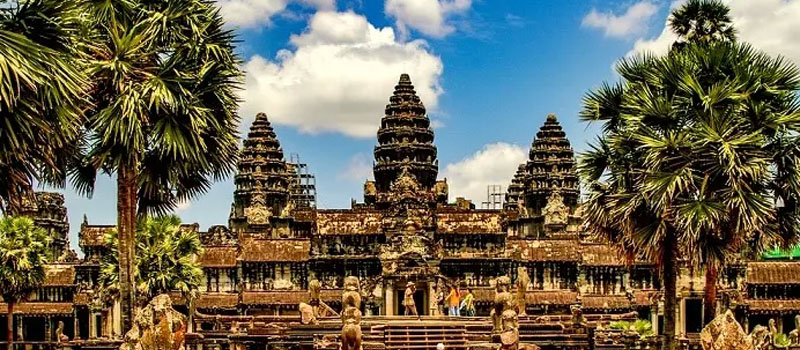
Getting to know Cambodia
Thailand runs along Cambodia’s western and northwestern edge, Laos sits to the northeast, Vietnam wraps around the east and south, and southwestern shores meet the Gulf of Thailand. Inside that ring, almost everything worth planning a trip around sits on or near the Mekong or the lake it feeds. Phnom Penh occupies the point where four channels meet at Chaktomuk: the Mekong arriving from the north, the Tonle Sap river flowing in from the great lake, and the Mekong splitting again below the city into what becomes, once it crosses into Vietnam, the Tien Giang and Hau Giang branches of the delta. Few capitals anywhere sit on that kind of hydrology.
The climate is tropical year-round, with a rainy season running roughly June to October and drier, more settled weather from November through May. That second stretch is when roads are easiest, boat crossings are calmest and the Kampi pool near Kratie holds the country’s wild Irrawaddy dolphin population close enough to shore for a good look. The rainy months bring the more dramatic version of the river story instead: from around June to November the Tonle Sap river reverses course entirely, pushed backwards by the rising Mekong, and pours into the lake rather than draining out of it, though recent data shows that reversal carrying less water than it used to.
Two kinds of travellers tend to end up here. One arrives for the temples alone, treats Siem Reap as the whole trip and adds Phnom Penh almost as an afterthought. The other is already building a longer Mekong itinerary through Vietnam or Laos and wants Cambodia’s stretch of river folded in properly, dolphins, floating villages and all, rather than just Angkor with a capital city bolted on. Khmer is spoken everywhere; the riel is the official currency, though US dollars change hands so freely that most prices are simply quoted in both.
Where to go in Cambodia
Good to know before you go
| Topic | Details |
|---|---|
| Season | Rainy season roughly June to October; dry season November to May, the steadier window for road travel and river crossings |
| Visa | E-visa costs USD 30, must be used to enter within 3 months of issue, and allows a stay of up to 30 days. Visa on arrival, about USD 30, is available at most airports and many land or river border posts |
| Angkor Pass | 1 day USD 37, 3 days USD 62, 7 days USD 72, covering Angkor Wat and the full archaeological park |
| Airports | Siem Reap–Angkor International Airport (SAI), roughly 50 km from central Siem Reap; Phnom Penh International Airport for the capital |
| Currency | Cambodian Riel (KHR); US dollars circulate everywhere alongside it and are accepted for almost any payment |
Planning your Cambodia trip
Our shortest Cambodia trips run three days and stay in a single city, Phnom Penh or Siem Reap alone. Most travellers take four to six days and combine both. Beyond that, Kratie’s dolphins and a loop through Tonle Sap’s floating villages and Battambang’s bamboo train turn a temple trip into something that shows more of the country than the standard capital-plus-Angkor pairing.
Cambodia also links naturally into a longer river itinerary. A boat crossing at the Mekong border near Chau Doc connects straight through to Phnom Penh, and from there the road runs on to Kratie or across to Laos. Let us know your travel window and whether a single country suits you better than a route that keeps following the water, and we will shape the plan around that.
How your trip is run in Cambodia
A local office based in Phnom Penh handles the ground arrangements behind our Cambodia itineraries, covering Angkor pass timing in Siem Reap and the official boat booking at Kampi for dolphin watching. Having people on the spot means a swapped hotel or a shifted flight gets sorted directly rather than relayed through somewhere on the other side of the world.