Getting to know Siem Reap
Nobody comes to Siem Reap for Siem Reap. They come for what the Khmer Empire built in the jungle around it over some six hundred years starting in the 800s, and the town has organised itself entirely around getting visitors out to see it and bringing them back for dinner. That arrangement works well: a compact old quarter, an easy tuk-tuk ride to the temple gates, and a genuinely lively evening scene once the day’s heat breaks.
The single biggest change in recent years is the airport. Siem Reap-Angkor International Airport opened on 16 October 2023 about 50 kilometres east of town, replacing the old airfield that sat close to the centre, and it built the drive into the trip in a way that never used to apply here. Factor in roughly an hour each way for transfers, and price the extra vehicle time into your first and last day rather than treating it as a footnote.
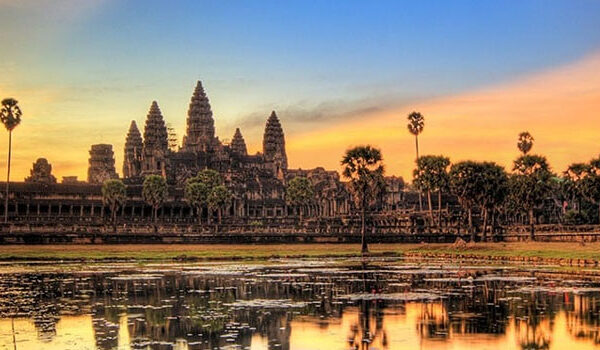
Angkor Wat draws the crowds, and the sunrise crowd in particular has become a genuine spectacle in its own right, with hundreds of visitors lining the reflecting pools before dawn. If that scene does not appeal, a mid-morning or late-afternoon visit trades the postcard silhouette for room to actually look at the carving, and starting a temple circuit at Angkor Thom or Preah Khan instead of Angkor Wat means walking against the crowd rather than through the middle of it.
Things to see and do
Angkor Wat
The largest religious monument on Earth, and still the single image most people picture when they think of Cambodia.
Angkor Thom and Bayon
A walled royal city with the Bayon’s carved stone faces at its centre, best explored on foot once inside the gates.
Ta Prohm
A temple left largely as it was found, with fig and silk-cotton tree roots grown through the stonework.
Banteay Srei
A smaller, finely carved 10th-century temple in pink sandstone, roughly 40 minutes outside town.
Preah Khan
A large, atmospheric complex of corridors and courtyards, quieter than the main circuit.
Tonle Sap floating villages
Boat trips out to communities built on and around Southeast Asia’s largest lake; see the Good to know section for which village to choose.
Pub Street and the old French quarter
The town’s evening centre, with restaurants, bars and night market stalls a short walk from most hotels.
Beng Mealea, a jungle-swallowed temple further out, and Kbal Spean, a riverbed carved with Hindu imagery, both sit outside the standard Angkor Pass circuit but can be added with a separate ticket, 10 USD and 5 USD, for travellers with an extra day to spend on quieter sites.
Good to know
| What | Detail |
|---|---|
| Angkor Pass pricing (2026) | 1 day USD 37, 3 days USD 62, 7 days USD 72 |
| Where to buy | Angkor Ticket Office (5:00am-5:30pm), online at angkorenterprise.gov.kh, or ticket machines at the Angkor Wat west gate and Heritage Walk Mall |
| Sites outside the pass | Beng Mealea (10 USD) and Kbal Spean (5 USD) sell separate tickets if not buying the full Angkor Pass |
| Airport transfer | Siem Reap-Angkor International Airport (SAI) sits about 50 km east of town; budget roughly an hour each way |
| Avoiding the Angkor Wat sunrise crowd | Start the day at Angkor Thom or Preah Khan instead, and visit Angkor Wat mid-morning or in the late afternoon |
| Tonle Sap floating villages | Kampong Khleang (about 55 km, least developed for tourism) and Kampong Phluk (about 35 km) are better choices than Chong Khneas (about 15 km), which draws frequent overcharging complaints |
Trips that include Siem Reap
Siem Reap combines easily with Phnom Penh, with Battambang and Tonle Sap as a side trip, or with a longer route down the Mekong into Vietnam. Send us your dates and how many temple days you want, and we will build a schedule around it.