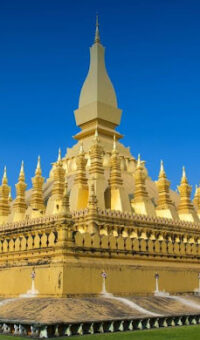
Getting to know Laos
Landlocked and bordered by China, Myanmar, Thailand, Cambodia and Vietnam, Laos is the only one of the four countries on this site where the Mekong is not an occasional feature of a trip but the spine running through nearly all of it. Luang Prabang sits directly on the river. Vientiane, the capital, faces Thailand across it. Pakse and Champasak sit along its banks in the south, and the country’s southernmost stretch, Si Phan Don, is made up of islands the river has split itself into. Very little travel here happens far from the water.
The climate follows a monsoon rhythm, wet from roughly May to October and dry from November to April, and the last stretch of that dry run, March into April, turns markedly warmer than its opening months. November through February gives the most reliable conditions for overland travel and river journeys alike, the slow boat down from the Thai border to Luang Prabang included, which still keeps to the same two-day pattern it always has.
Laos suits a slower pace of travel than its neighbours, and that is a deliberate contrast rather than a shortcoming: fewer big-ticket sights, more time on the water, and towns that have not been rebuilt around tour buses the way some elsewhere in the region have. It works well as a fourth country added after Vietnam, Cambodia or Thailand, and just as well as a standalone trip built entirely around the river. Lao is spoken nationwide, and the kip is the local currency, though it is used far more consistently here than the riel is in Cambodia, so carrying local cash matters more.
Where to go in Laos
Good to know before you go
| Topic | Details |
|---|---|
| Season | Rainy season roughly May to October; dry season November to April, the steadier window for travel |
| Visa | Visa on arrival USD 35–50 depending on nationality; e-visa through laoevisa.gov.la costs about the same and takes roughly 3 days to process, but is not valid for overland entry from Vietnam |
| Lao–China railway | Vientiane to Luang Prabang in about 2 hours; second-class tickets run around 330,000 kip |
| Main crossings | Thai–Lao Friendship Bridge 1, Nong Khai–Vientiane; Friendship Bridge 4, Chiang Khong–Huay Xai |
| Currency | Lao Kip (LAK), used more consistently day to day than USD |
Planning your Laos trip
A short Luang Prabang stay of three or four nights works well on its own or as an add-on to Vietnam or Thailand. Pair it with Vientiane and the trip stretches to five or six nights; add Champasak and Si Phan Don in the south and you are looking at a full loop of the country rather than a single stop.
The slow boat from Huay Xai down to Luang Prabang is worth building a trip around rather than treating as transport, since two days on the river with an overnight stop at Pakbeng is a genuinely different way to arrive than flying straight in. Tell us how much time you have and whether the river itself matters to you or just the destinations at either end, and we will route the trip accordingly.
How your trip is run in Laos
Our Laos arrangements are handled by a team on the ground rather than booked remotely and left to run themselves, which matters more here than in some neighbouring countries: boat schedules, road conditions in the north and hotel availability in Luang Prabang can all shift with little notice, and a local contact is what lets us adjust quickly rather than after the fact.