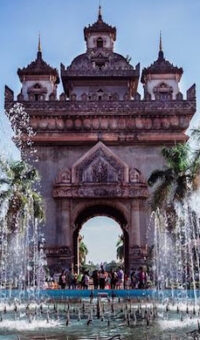
Getting to know Vientiane
Vientiane sits directly on the Mekong, with the Thai province of Nong Khai visible across the water. It is one of the quieter capitals in the region: wide, tree-lined boulevards, a skyline that stays low, and a pace closer to a provincial town than a seat of government. That is generally the point of stopping here rather than something to work around.
The city rewards a slow day more than a checklist. A morning covers the main temples and the national monument at an easy walk or short tuk-tuk ride, and by late afternoon the riverside promenade fills with joggers, food stalls and a night market that runs along the bank as the light fades. Watching the sun go down over the Mekong, with the outline of Thailand on the far bank, is as much a Vientiane activity as any single sight.
Vientiane also functions as the country’s transport hub. The Laos–China railway has a station here, putting Vang Vieng roughly an hour away and Luang Prabang about two, and the Thai–Lao Friendship Bridge across the Mekong makes this the busiest overland crossing between the two countries. Most Laos itineraries either start or end in the capital for exactly that reason.
Things to see and do
Patuxai
A Khmer-style triumphal arch in the centre of the city, built with cement partly donated for a runway that was never finished; climb it for a view down the main boulevard.
Wat Sisaket
The oldest surviving temple in Vientiane, its cloister walls lined with thousands of small Buddha images.
Pha That Luang
The gold-covered stupa that serves as Laos’s national symbol, on the eastern edge of the city.
Talat Sao, the morning market
A covered market selling everything from gold jewellery to household goods, busiest earlier in the day.
The Mekong riverside and night market
A promenade that fills with food stalls, exercise groups and a stretch of night-market stands as the sun drops over the river toward Thailand.
Vang Vieng day or overnight trip
Tubing on the Nam Song, a Mekong tributary rather than the main river itself, plus the Blue Lagoon swimming holes; now reachable by fast train in about an hour.
Vang Vieng is worth being precise about: the tubing and swimming happen on the Nam Song river, a tributary that joins the Mekong further downstream, not on the Mekong itself. It still makes a straightforward add-on to a Vientiane stay now that the railway connects the two towns in around an hour, whether as a day trip or an overnight break on the way north to Luang Prabang.
Good to know
| What | Detail |
|---|---|
| Thai–Lao Friendship Bridge | Crosses the Mekong to Nong Khai, Thailand, about 20 km from central Vientiane; both rail and road/bus traffic use it |
| Laos–China railway station | In Vientiane; fast train to Vang Vieng about 1 hour, to Luang Prabang about 2 hours |
| Vang Vieng’s river | Nam Song, a Mekong tributary — not the Mekong mainstream itself |
| Talat Sao morning market | Busiest earlier in the day; quieter by mid-afternoon |
| Riverside promenade | Best in the late afternoon and evening, with food stalls and a night market along the Mekong bank |
| Currency | Lao Kip (LAK) |
Trips that include Vientiane
Vientiane usually works best as one or two nights bookending a longer Laos trip rather than a standalone destination. Let us know which direction you are travelling, north to Luang Prabang or south toward the islands, and how many nights you have, and we will build the route around it.