Getting to know Luang Prabang
Luang Prabang was the seat of Laos’s royal family for six centuries, set on a narrow peninsula where the Nam Khan river slides into the Mekong. UNESCO listed the old town as a World Heritage Site in 1995, protecting a townscape where saffron-robed monks, French colonial shophouses and gilded temple roofs share the same low skyline. Nothing here rises much above the treetops, and that restraint is a large part of what keeps the town’s character intact.
The pace suits early risers. Streets that carry a steady flow of motorbikes by midday are quiet enough at dawn for the town’s best-known ritual, and the heat that builds through the afternoon makes an early start worth planning around. Cafes along the main street open before sunrise to match, and the Mekong itself is never more than a short walk from wherever you are staying.
Most visitors give Luang Prabang three or four nights: enough for the temples and museum in town, a full day out to the region’s waterfalls and caves, and at least one evening on the river. It also sits at either end of two very different journeys into Laos: a two-hour dash from Vientiane on the new railway, or the slow, unhurried finish of a two-day boat trip down from the Thai border.
Things to see and do
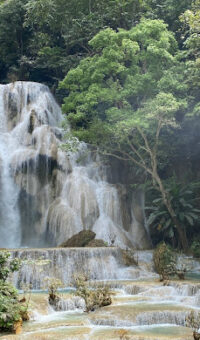
Kuang Si Falls
A multi-tier waterfall outside town, with turquoise pools cut into limestone terraces. The walk up to the higher falls is steeper than the lower pools most visitors stop at.
Pak Ou Caves
Two caves packed with thousands of Buddha statues, reached by boat heading upriver on the Mekong — a half-day trip that doubles as a river outing in its own right.
Tak Bat, the morning alms round
Lines of monks collect rice from kneeling townspeople at first light. Watch from a distance, skip the flash, and avoid the sticky rice sold from carts along the pavement; if you want to take part rather than just watch, ask your hotel to prepare proper offerings instead.
Royal Palace Museum
The former residence of Laos’s royal family, kept largely as it was left, with royal regalia and gifts from foreign governments on display.
Mount Phousi
A short, steep climb of a few hundred steps in the middle of town, ending at a stupa with a wide view over the rooftops and the river at sunset.
The night market
Handicrafts and textiles fill the closed-off main street each evening, with a food alley worth a stop before or after browsing.
A Mekong sunset boat trip
An hour or two on the river as the light drops, usually with a drink in hand — one of the simplest, least planned things to do in town.
Kuang Si and Pak Ou are usually done as separate half or full days rather than combined, since Kuang Si sits by road to the south while Pak Ou is reached by boat heading north up the Mekong. Between them and Mount Phousi, two full days outside the old town cover the region’s major sights without doubling back.
Good to know
| What | Detail |
|---|---|
| Fast train from Vientiane | About 2 hours; foreign fares from 330,000 kip (2nd class) to 522,000 kip (1st class) and 975,000 kip (business) |
| Slower K11/K12 trains | 579,000 kip for a soft sleeper, 234,000 kip for a hard seat |
| Train station location | Outside the town centre — budget extra time for the transfer in either direction |
| Slow boat from Huay Xai | 2-day public boat down the Mekong, overnighting in Pakbeng, ending in Luang Prabang |
| Tak Bat etiquette | Watch at a distance, no flash photography, do not buy roadside offerings sold to tourists |
| Currency | Lao Kip (LAK) |
Trips that include Luang Prabang
Luang Prabang works equally well as a short stay on its own or as one stop on a longer route through Laos. Tell us how you would rather arrive, by train, slow boat or road, and how many nights you have, and we will build the schedule around it.