Trip overview
Most Siem Reap itineraries stop at the temples and a floating village fifteen minutes from town. This one goes further on both counts. The Angkor days cover the full pass, not a rushed half-day at Angkor Wat alone, and the floating village is Kampong Khleang, an hour’s drive east of Siem Reap and genuinely built around fishing rather than tour buses. From there the route runs west to Battambang, where the original bamboo train still runs on a real stretch of colonial-era track.
We route Kampong Khleang ahead of Chong Khneas deliberately. Chong Khneas is the closest floating village to Siem Reap, about 15 km out, and it is also the one with the most complaints about boat operators steering visitors into overpriced restaurants and souvenir stops. Kampong Khleang, at roughly 55 km, is the largest floating settlement on the lake and the least set up for tourism, which means a longer drive in exchange for a village that looks the way it does regardless of who is watching.
Trip highlights
- Angkor Wat, the Bayon and Ta Prohm on a multi-day Angkor Pass, not a single rushed visit
- Kampong Khleang, the largest floating village on the Tonle Sap and the least touristed of the three usual options
- Battambang’s original bamboo train, 5 km from town, running on genuine rail line rather than a purpose-built loop
- Battambang’s French colonial-era shophouses and riverside old town
- A guide who explains what Tonle Sap’s reversing flow is doing this year, not a stock description from a decade ago
- Time built in around temple visits rather than a fixed sunrise-to-sunset sprint
Your day-by-day itinerary
Day 1: Arrive Siem Reap
Transfer from Siem Reap–Angkor International Airport, about 50 km from the town centre, to your hotel. The rest of the day is free to recover from the flight; your guide will confirm the next four days’ timing with you that evening, since temple visits are built around light and heat rather than a fixed clock.
Day 2: Angkor Wat at sunrise, the Bayon and Ta Prohm
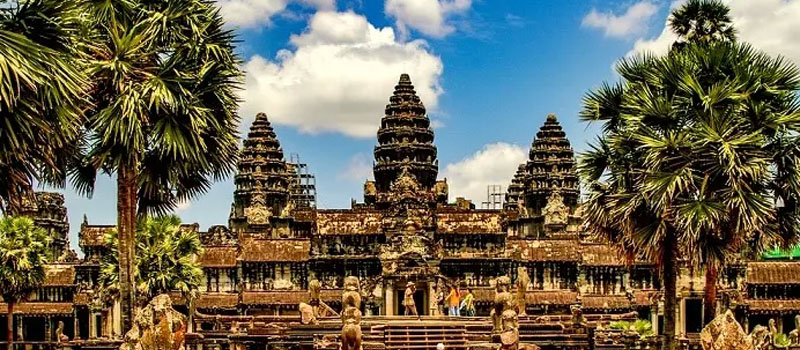
An early start for Angkor Wat as the light comes up over the towers, then the walled city of Angkor Thom and the Bayon’s carved stone faces, and Ta Prohm, where tree roots have grown through the temple structure since it was left unrestored. This is the standard Angkor Pass day, and we take it at a pace that leaves the afternoon free rather than adding a fourth or fifth temple just to fill hours.
Day 3: Kampong Khleang floating village, then a second day inside the Angkor complex
A morning drive of about an hour east of Siem Reap to Kampong Khleang, the largest floating village on the Tonle Sap and the one built most plainly around fishing rather than visitors. Houses stand on stilts ten metres and more above the ground in dry season, dropping to water level once the lake rises; boats replace roads for months at a stretch. Note that in the driest part of the year, roughly February to May, low water can keep boats from reaching the deepest parts of the village, and November, once the wet season has filled the lake but before it starts to drop, is usually the easiest month to get in close. In the afternoon you return to Angkor for a second temple day, using the multi-day pass to reach sites like Banteay Srei or Preah Khan that a one-day ticket does not usually allow time for.
Day 4: Drive to Battambang, the original bamboo train and the old town
The road west to Battambang takes around three hours. On arrival you head straight to the bamboo train, 5 km from the town centre, which runs on an actual stretch of railway track rather than a dedicated loop. Bamboo-platform cars called norries ride the rails at a fair clip; when two meet going opposite directions, the lighter load is lifted off the track to let the other pass, then set back down. A shared ride costs around 5 USD, a private car around 10 USD. This is deliberately not the newer Banon Bamboo Train about 21 km out, which is a purpose-built amusement park with a 3 km private loop charging roughly 7.25 USD; it is a different experience and not the one most visitors are looking for when they ask about Battambang’s bamboo train. The afternoon covers the old town’s French colonial shopfronts along the Sangker River on foot.
Day 5: Battambang to Siem Reap, departure
Drive back to Siem Reap in time for your onward flight from Siem Reap–Angkor International Airport. If your flight is in the afternoon, the morning can be used for one more Angkor temple or left free.
What’s included
- Hotels in the class you choose, twin or double occupancy, with breakfast each morning, or an equivalent property if the one named is full.
- All meals written into the day-by-day programme below.
- A private air-conditioned vehicle for every transfer and excursion in the programme.
- An English-speaking local guide at each stop on the route.
- Every boat trip, river crossing and cruise named in the itinerary.
- Entrance fees for the sites listed in the programme.
- Drinking water in the vehicle and on boat days.
- Government tax and service charge.
Not included
- International and domestic flights, and rail tickets.
- Visas, and any fee collected at a border post.
- Travel insurance.
- Meals and drinks that are not written into the programme.
- Personal spending such as laundry, phone calls, minibar, souvenirs and watersports.
- Early check-in, late check-out and room upgrades.
- Anything added on the day at your request outside the printed programme.
- Gratuities for your guide and driver.
- Costs arising from weather, flooding, road closures or other events beyond our control.
- Bank transfer charges.
Booking this trip
- Days
- 5 days / 4 nights
Sending this does not charge you. We hold the space and confirm within 24 hours.
For visas, payment terms and what to expect on arrival, see [Cambodia travel information](cambodia/travel-information).
Send us your travel dates and group size and we will confirm availability and build your Angkor Pass into the schedule.