Trip overview
This trip follows the Mekong south through two countries that share a river but very little else in pace or mood. Laos opens slowly: three nights in Luang Prabang, a fast train ride to the capital, then a flight or a long day on the road down to Pakse in the south, where the river widens out around the islands of Si Phan Don. From there you cross by land into Cambodia and keep heading south to Kratie, then finish in Phnom Penh, the busiest city on the route by a wide margin.
One fact we put here rather than let you discover on the ground: the Irrawaddy dolphins that used to draw visitors to Si Phan Don are gone. The last individual in that stretch of river died in February 2022, and the population there is locally extinct. The dolphin encounter on this trip happens later, at Kratie in Cambodia, roughly 117 individuals as of April 2026 and the only reliable place left on the Mekong to see them in the wild. We build the itinerary around that reality rather than around outdated marketing that still promises dolphins on the Lao islands.
Trip highlights
- Three nights in Luang Prabang: Kuang Si waterfall, the Pak Ou caves reached by boat upriver, dawn alms-giving on the main streets, and sunset from Mount Phousi
- The Laos–China railway from Luang Prabang to Vientiane, a journey that now takes about two hours instead of a full day on the road
- Wat Phou, a UNESCO World Heritage Khmer temple at Champasak that predates Angkor Wat
- Don Det and Don Khon in Si Phan Don, with the wide rapids of Khone Phapheng and the quieter falls at Li Phi
- A land border crossing from Laos into Cambodia, continuing south through Stung Treng to Kratie
- Wild Irrawaddy dolphins on the Mekong at Kratie, the species’ last real stronghold on this river
Your day-by-day itinerary
Day 1: Arrive Luang Prabang
Transfer from the airport into town, with the rest of the day free. Luang Prabang’s old quarter, a UNESCO World Heritage Site, is easy to walk on your own before the trip properly begins; the night market along the main street is worth an hour if you land in time for it.
Day 2: Kuang Si waterfall
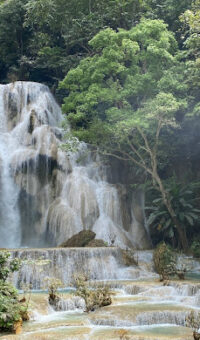
A full day given to Kuang Si, a series of turquoise pools stepping down through the forest outside town, with a rescue centre for Asiatic black bears near the entrance. It is an easy, mostly flat walk between the lower pools and the main falls, with swimming possible in several of them.
Day 3: Dawn alms-giving, Pak Ou caves and Mount Phousi
An early start for the Tak Bat, the daily alms-giving ceremony that still runs at dawn along Luang Prabang’s main streets, with monks in saffron robes collecting rice from kneeling residents; your guide will brief you beforehand on how to observe respectfully and from a distance. Later in the morning you take a boat upriver on the Mekong to the Pak Ou caves, two limestone caverns packed with thousands of Buddha images left by generations of pilgrims. The afternoon covers the Royal Palace Museum, the former residence of the Lao monarchy, and closes with the climb up Mount Phousi in the centre of town for sunset over the Mekong and the old quarter below.
Day 4: Luang Prabang to Vientiane by rail
The Laos–China railway covers the roughly 400 km between Luang Prabang and the capital in about two hours, second class costing around 330,000 kip and first class around 522,000 kip. It is a striking change from the eight-to-ten-hour road journey this route used to require. The afternoon in Vientiane takes in Patuxai, the city’s triumphal arch, Wat Sisaket with its thousands of small Buddha niches, and Pha That Luang, the gold-covered stupa that is Laos’s national symbol.
Day 5: Vientiane to Pakse, on to Champasak and Wat Phou
A flight south to Pakse, then a short transfer to Champasak on the west bank of the Mekong. Wat Phou sits on the slope of Phu Kao mountain just outside town, a Khmer temple complex built along the same axial principle later used at Angkor and recognised as a UNESCO World Heritage Site. It sees a fraction of Angkor’s visitor numbers on any given day. You overnight in the Pakse or Champasak area.
Day 6: South to Si Phan Don
The road south from Pakse to Si Phan Don, the Four Thousand Islands, runs a few hours and ends at a short boat crossing to Don Det or Don Khon depending on your hotel. In the afternoon you visit Khone Phapheng, a chain of rapids running more than 10 km along this stretch of the river and often described as the largest waterfall in Southeast Asia by volume, though it is really a sustained run of white water rather than a single drop.
Day 7: Si Phan Don — Li Phi falls and the islands
A slower day on the islands: Li Phi falls, reached by a short walk or bicycle ride from the old French colonial bridge linking Don Det and Don Khon, and the remains of the French-era railway built over a century ago to portage cargo around these very rapids. Cycling the flat lanes between the two islands is the easiest way to fill the rest of the day, with the Mekong visible from almost every point on either island.
Day 8: Cross into Cambodia, on to Kratie for the dolphins
A short transfer to the Laos–Cambodia border, then a land crossing into Stung Treng province and a drive south along the river to Kratie. This is also where we put the plain fact stated above into practice: the dolphins you came hoping to see are not on the Lao islands you just left, they are here. In the afternoon you go out on a boat run by the official Kampi service, about 15 km north of Kratie town, watching for Irrawaddy dolphins to surface. The population stood at 117 individuals as of April 2026, and sightings are most reliable from December to February, when low water concentrates the animals near Kampi; outside that window the river spreads out and the dolphins disperse.
Day 9: Kratie to Phnom Penh
A morning free in Kratie’s small French-era quarter, or a bicycle loop of Koh Trong, the river island opposite town, before the drive south to Phnom Penh. You arrive by late afternoon with the evening free along Sisowath Quay, the riverfront promenade that looks out over Chaktomuk, the point where the Mekong, the Tonle Sap and the Bassac all meet.
Day 10: Phnom Penh, departure
A last morning in the capital before your flight, depending on timing: the Royal Palace complex and the Silver Pagoda, or the National Museum with its collection of Angkorian sculpture, both a short walk from the riverfront. Transfer to Phnom Penh International Airport closes out the trip.
What’s included
- Hotels in the class you choose, twin or double occupancy, with breakfast each morning, or an equivalent property if the one named is full.
- All meals written into the day-by-day programme below.
- A private air-conditioned vehicle for every transfer and excursion in the programme.
- An English-speaking local guide at each stop on the route.
- Every boat trip, river crossing and cruise named in the itinerary.
- Entrance fees for the sites listed in the programme.
- Drinking water in the vehicle and on boat days.
- Government tax and service charge.
Not included
- International and domestic flights, and rail tickets.
- Visas, and any fee collected at a border post.
- Travel insurance.
- Meals and drinks that are not written into the programme.
- Personal spending such as laundry, phone calls, minibar, souvenirs and watersports.
- Early check-in, late check-out and room upgrades.
- Anything added on the day at your request outside the printed programme.
- Gratuities for your guide and driver.
- Costs arising from weather, flooding, road closures or other events beyond our control.
- Bank transfer charges.
Booking this trip
- Days
- 10 days / 9 nights
Sending this does not charge you. We hold the space and confirm within 24 hours.
For visas, payment terms and what to expect at the Laos–Cambodia border, see [Travel information for the Mekong countries](mekong/travel-information).
Send us your travel dates and group size and we will confirm availability across Luang Prabang, Vientiane, Pakse, Si Phan Don, Kratie and Phnom Penh.