Trip overview
There are two ways to link Angkor and the Mekong Delta, and this is the one that actually makes sense on the ground. You fly into Siem Reap, spend three nights around the temples and Tonle Sap, then follow the river downstream through Phnom Penh, across the border by boat at Chau Doc, and on through the delta to Saigon. Going with the current keeps every travel day short and every transfer logical. It also solves a problem the reverse route runs straight into: Can Tho has no international flights at all, so a trip that starts in the delta has to end with a long backtrack to Ho Chi Minh City anyway. This way, you end in Saigon once, at Tan Son Nhat, the only airport on the route with real international connections.
The shape of the trip is temples, then lake, then river, then delta. Three nights in Siem Reap cover the main Angkor circuit and a slower morning on Tonle Sap. Two nights in Phnom Penh give the capital proper time rather than a rushed afternoon. Then the pace changes: a river boat carries you across the international border into Vietnam, and the last three nights move through Chau Doc, Can Tho and Saigon, the classic run of the Mekong Delta itself.
Trip highlights
- Two full days at Angkor Wat, Angkor Thom and the Bayon, with time built in rather than a single sprint through the main sites
- Tonle Sap by boat to Kampong Khleang, a floating village 55 km from Siem Reap that sees far fewer tour groups than the lake’s closer villages
- An international river crossing by boat from Phnom Penh to Chau Doc, entering Vietnam at the Kaam Samnor–Vinh Xuong border post
- Cai Rang floating market near Can Tho at first light, while the trading boats that remain are still out on the water
- A route built to end in Saigon, the one city on this trip with direct international flights out
Your day-by-day itinerary
Day 1: Arrive Siem Reap
Siem Reap–Angkor International Airport sits about 50 km from the town centre, a longer transfer than the old airport it replaced, so plan on roughly an hour on the road after landing. Your guide meets you at arrivals and takes you into town, with the rest of the day free to settle in, adjust to the heat and walk down to the night market if you land early enough. We hold the temples for tomorrow rather than rushing you straight from the airport into ruins.
Day 2: Angkor Thom, the Bayon and Angkor Wat
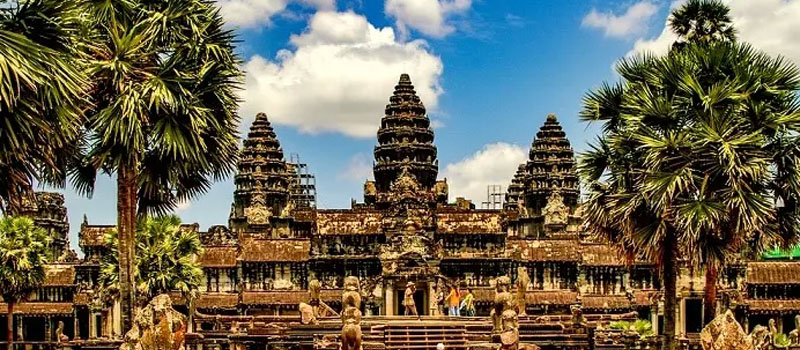
A full day on the main Angkor circuit: the walled city of Angkor Thom and its central temple, the Bayon, with its stone faces looking out in four directions from every tower, then Ta Prohm, where tree roots still grip the stonework, and Angkor Wat itself in the afternoon or at sunset depending on the light and the crowds that day. Entry runs on the Angkor Pass system, priced at 37 USD for one day, 62 USD for three days or 72 USD for seven, and we generally recommend the three-day pass for this itinerary since it gives you room to add a further temple on Day 3 if the morning at Tonle Sap runs short.
Day 3: Tonle Sap and the floating village of Kampong Khleang
Southeast Asia’s largest lake changes size dramatically between wet and dry season, and the river that connects it to the Mekong at Phnom Penh actually reverses direction each year as the flood arrives. That reversal has weakened over the past two decades, mainly due to sand dredging along the Mekong, so we no longer describe Tonle Sap’s flood pulse as if nothing had changed. For the floating village itself we take you to Kampong Khleang, about 55 km from Siem Reap, over the closer but heavily touristed Chong Khneas, where boat operators are known to steer visitors into overpriced stops. Kampong Khleang is a working community built on stilts and pontoons, with a school and a clinic among the houses, and it stays honest in a way the nearer villages no longer do. The afternoon is free, or can be used against your Angkor Pass for an outlying temple such as Banteay Srei.
Day 4: Siem Reap to Phnom Penh
An overland transfer south to the capital, roughly five to six hours by private vehicle with a stop along the way. It is a working travel day rather than a sightseeing one, and it puts you in Phnom Penh by early evening with the rest of the night free.
Day 5: Phnom Penh — Royal Palace, National Museum and the Khmer Rouge memorial sites
The morning covers the Royal Palace complex and the Silver Pagoda, then the National Museum and its collection of Angkorian sculpture, all within walking distance of the riverfront at Sisowath Quay. The afternoon turns to Tuol Sleng, the former school used as the S-21 prison under the Khmer Rouge, and Choeung Ek, one of the killing fields on the city’s outskirts. Both sites are handled plainly, with time to absorb them rather than a rushed commentary.
Day 6: Phnom Penh to Chau Doc by river boat, crossing the border at Kaam Samnor–Vinh Xuong
This is the day the whole trip is built around: a boat down the Mekong from Phnom Penh to Chau Doc, crossing the international border by river rather than by road. The journey takes about five to six and a half hours including the border formalities, run by one of a small number of operators licensed on this route. Vietnam entry here matters for planning: Vinh Xuong is an approved port of entry for the Vietnam e-visa, so a pre-arranged e-visa works at this crossing, but there is no visa-on-arrival for Vietnam by river or by road anywhere on this border, so it has to be sorted before you fly to Cambodia, not on the boat.
Day 7: Chau Doc — Sam Mountain and Tra Su forest, then on to Can Tho
Since the 2025 provincial merger, Chau Doc now sits within An Giang province, but the town itself is unchanged: Sam Mountain and its pilgrimage temple, Ba Chua Xu, whose annual festival was inscribed by UNESCO as intangible cultural heritage in December 2024, remain the reason most visitors stop here. About 30 km away, Tra Su melaleuca forest is at its best from September to November when the flooded forest fills with birdlife, reached by motorboat or hand-paddled sampan through the flooded canopy. From there it is a drive of a few hours south to Can Tho for the night.
Day 8: Cai Rang floating market at dawn, then to Saigon
An early start for Cai Rang, about 6 km from central Can Tho by boat. We tell it straight: this market has shrunk from several hundred trading boats in its busiest years to roughly a hundred today, and what is left thins out fast after mid-morning, so the 5 to 7 a.m. window is not a marketing line, it is the only time the market still looks like itself. From Can Tho the drive to Saigon runs on the expressway in around two hours, a fraction of what it took before the road opened, and you check in for your final night with the evening free.
Day 9: Saigon, departure
A last few hours in the city before your flight, depending on departure time: Notre-Dame Cathedral, still under a long restoration that will not be finished by 2027 but viewable from the square outside, the century-old Central Post Office across from it, and Ben Thanh Market if you have time for a final walk. Transfer to Tan Son Nhat for your international departure closes out the trip.
What’s included
- Hotels in the class you choose, twin or double occupancy, with breakfast each morning, or an equivalent property if the one named is full.
- All meals written into the day-by-day programme below.
- A private air-conditioned vehicle for every transfer and excursion in the programme.
- An English-speaking local guide at each stop on the route.
- Every boat trip, river crossing and cruise named in the itinerary.
- Entrance fees for the sites listed in the programme.
- Drinking water in the vehicle and on boat days.
- Government tax and service charge.
Not included
- International and domestic flights, and rail tickets.
- Visas, and any fee collected at a border post.
- Travel insurance.
- Meals and drinks that are not written into the programme.
- Personal spending such as laundry, phone calls, minibar, souvenirs and watersports.
- Early check-in, late check-out and room upgrades.
- Anything added on the day at your request outside the printed programme.
- Gratuities for your guide and driver.
- Costs arising from weather, flooding, road closures or other events beyond our control.
- Bank transfer charges.
Booking this trip
- Days
- 9 days / 8 nights
Sending this does not charge you. We hold the space and confirm within 24 hours.
For visas, payment terms and what to expect at each border on this route, see [Travel information for the Mekong countries](mekong/travel-information).
Send us your travel dates and group size and we will confirm availability across Siem Reap, Phnom Penh, Chau Doc, Can Tho and Saigon, including a seat on the river crossing.