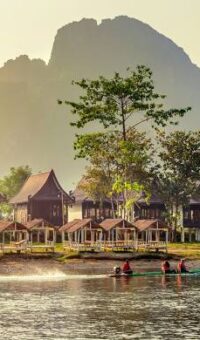
Trip overview
A river usually gets one name and keeps it. This one gets three. In Laos it is Mae Nam Khong, in Cambodia it is Tonlé Thom, and by the time it reaches the Vietnamese delta it has split into nine channels and taken the name Cửu Long, the Nine Dragons. This trip follows that single thread of water from the point where it is still a fast, cold, mountain-fed river running past Luang Prabang, down through the temples of Champasak, across a border into Cambodia to watch for the last river dolphins on this stretch of the Mekong, into Phnom Penh, and on by boat into Vietnam to the delta where the river finally gives up and becomes the sea.
Most itineraries that cover Laos, Cambodia and Vietnam treat them as three separate countries joined by flights. This one treats them as one river with three names, and moves the way the water does: south, then southeast, then splitting into channels at the end. You will cross two international land and river borders, ride the Laos–China railway for a short stretch, take a slow boat through Cambodia and a passenger boat into Vietnam, and end at a floating market that is smaller and more honest than the postcards suggest. Twelve days is enough to do this properly without rushing any one country to fit in the next.
Trip highlights
- Three nights in Luang Prabang, with the dawn alms-giving procession, Kuang Si waterfall and the Pak Ou caves
- Wat Phou, the Khmer temple ruin below Phu Kao mountain at Champasak, a UNESCO World Heritage site
- Si Phan Don, the Four Thousand Islands, and Khone Phapheng, the Mekong’s widest waterfall
- Irrawaddy river dolphins at the Kampi pool near Kratie, best seen December to February
- Two nights in Phnom Penh for the Royal Palace, the Killing Fields and Tuol Sleng
- A river crossing from Cambodia into Vietnam, ending at Cai Rang floating market at dawn
Your day-by-day itinerary
Day 1: Arrive Luang Prabang
Transfer to your hotel in Luang Prabang, the town where this whole journey begins. Set at the point where the Nam Khan river meets the Mekong, Luang Prabang has spent the last three decades as a UNESCO World Heritage town without losing the working temples, the market stalls and the slow pace that made it worth protecting in the first place. The rest of the day is free to walk the peninsula between the two rivers before the trip gets moving properly tomorrow.
Day 2: Luang Prabang, Kuang Si waterfall and the old town
A half-day out to Kuang Si waterfall, a series of turquoise pools stepping down through forest outside town, with time to swim in the lower pools before the afternoon crowds arrive. Back in Luang Prabang, the afternoon covers the Royal Palace Museum, a run of temples along the peninsula, and the climb up Mount Phousi for the view over the confluence of the two rivers as the light drops.
Day 3: Dawn alms procession and the Pak Ou caves
An early start for the alms-giving procession, when lines of monks in saffron robes walk the main street at dawn to collect food from residents and visitors; your guide will explain beforehand how to take part respectfully, or simply to watch from a distance instead. Later in the morning, a boat trip upriver on the Mekong to the Pak Ou caves, two limestone caverns in a cliff face packed with thousands of Buddha images left by pilgrims over centuries. The afternoon is free for the night market.
Day 4: Luang Prabang to Vientiane by rail (about 2 hours)
The Laos–China railway covers the distance between Luang Prabang and Vientiane in around two hours, a stretch that used to take most of a day by road through the mountains. In Vientiane, a lower-key capital than most, the afternoon takes in Pha That Luang, the gold-covered stupa that is Laos’s national symbol, Wat Sisaket with its thousands of small Buddha niches, and Patuxai, the Vientiane arch built with cement originally intended for a new airport runway.
Day 5: Vientiane to Pakse, transfer to Champasak and Wat Phou
A short flight south to Pakse, the gateway to southern Laos, followed by a drive to the riverside town of Champasak. In the afternoon, Wat Phou: a Khmer temple complex built centuries before Angkor, laid out on an axis running up the slope of Phu Kao mountain to a sanctuary with views back over the Champasak plain and the Mekong below. It is quieter than anything you will see in Cambodia later in this trip, and older than most of it.
Day 6: Bolaven Plateau to Si Phan Don, the Four Thousand Islands
A morning drive up onto the Bolaven Plateau, Laos’s coffee-growing highlands, with stops at waterfalls including Tad Fane before continuing south to Si Phan Don, where the Mekong spreads out to more than 10 kilometres wide and breaks into a maze of islands and channels. You settle in on Don Det or Don Khon for the night, reachable only by boat, with no cars and very little to do after dark beyond watching the river.
Day 7: Si Phan Don to Kratie, crossing into Cambodia
A morning at Khone Phapheng, the widest waterfall on the Mekong by volume, and a walk along the ruins of the old French colonial railway built to carry cargo around the rapids. One note worth being direct about: this stretch of the Mekong lost its resident population of Irrawaddy dolphins in February 2022, and no dolphin-watching trip is offered here despite what some older guidebooks still claim. In the afternoon, an overland crossing into Cambodia and on to Kratie, where the dolphins this trip is built around are actually still found.
Day 8: Kratie, Irrawaddy dolphins at Kampi, to Phnom Penh
An early boat out to the Kampi pool, 15 kilometres north of Kratie, where a small population of Irrawaddy dolphins, 117 individuals as of the most recent count in April 2026, surfaces in the slower water. Sightings are not guaranteed on any single outing, but this is genuinely the last reliable place on the Mekong to see them, and the dry-season months from December to February give the calmest water and the best odds. In the afternoon, a drive down to Phnom Penh for a two-night stay.
Day 9: Phnom Penh, Royal Palace, S21 and the Killing Fields
A full day in the Cambodian capital, split between the ceremonial and the difficult. The morning covers the Royal Palace and Silver Pagoda on the riverfront, then Tuol Sleng, the former school turned Khmer Rouge prison known as S21, and Choeung Ek, the Killing Fields memorial outside the city. Your guide sets the pace and gives you the option to skip either site if you would rather not visit them; most travellers find the context worth the discomfort.
Day 10: Phnom Penh to Chau Doc by river boat
A passenger boat down the Mekong from Phnom Penh into Vietnam, crossing the border at the river checkpoint of Kaam Samnor on the Cambodian side and Vinh Xuong on the Vietnamese side. One detail that catches travellers out: a Cambodian e-visa arranged online is not accepted at this particular crossing on the way out, and a Vietnamese e-visa is accepted on arrival at Vinh Xuong. You arrive into Chau Doc, a river town near Sam Mountain, by mid-afternoon.
Day 11: Chau Doc to Can Tho
A drive south to Can Tho, the largest city in the Mekong Delta since the 2025 provincial merger folded in the neighbouring provinces. The afternoon is unhurried, with an early night ahead of tomorrow’s early start for the floating market.
Day 12: Cai Rang floating market at dawn, transfer to Ho Chi Minh City
An early boat out to Cai Rang floating market, the largest of the delta’s wholesale markets and worth being honest about: it now has around 100 boats trading, down from several hundred at its peak, busiest between roughly 5:00 and 7:00 in the morning before the wholesale trade thins out. It is smaller than the photographs suggest, and still worth the early start. Afterwards, a transfer to Ho Chi Minh City, arriving in the afternoon in time for an international flight home or onward.
What’s included
- Hotels in the class you choose, twin or double occupancy, with breakfast each morning, or an equivalent property if the one named is full.
- All meals written into the day-by-day programme below.
- A private air-conditioned vehicle for every transfer and excursion in the programme.
- An English-speaking local guide at each stop on the route.
- Every boat trip, river crossing and cruise named in the itinerary.
- Entrance fees for the sites listed in the programme.
- Drinking water in the vehicle and on boat days.
- Government tax and service charge.
Not included
- International and domestic flights, and rail tickets.
- Visas, and any fee collected at a border post.
- Travel insurance.
- Meals and drinks that are not written into the programme.
- Personal spending such as laundry, phone calls, minibar, souvenirs and watersports.
- Early check-in, late check-out and room upgrades.
- Anything added on the day at your request outside the printed programme.
- Gratuities for your guide and driver.
- Costs arising from weather, flooding, road closures or other events beyond our control.
- Bank transfer charges.
Booking this trip
- Days
- 12 days / 11 nights
Sending this does not charge you. We hold the space and confirm within 24 hours.
For visas, border crossings and what to expect at each stage of this route, see [Travel information for the Mekong countries](mekong/travel-information).
Send us your travel dates and group size and we will confirm availability across all three countries.