Three kinds of boat, three different trips
The word ‘cruise’ gets applied to three quite different things on this river, and it’s worth separating them before you look at a single itinerary. The first is the overnight cruise ship, a small vessel with cabins that you sleep aboard for several nights while it moves slowly between Vietnam and Cambodia. The second is the day boat, used for a single excursion, a floating-village visit, or a short stretch of a longer land-based itinerary, with no cabins and no overnight stay aboard. The third is the fast passenger boat, built to get you from one town to another in a few hours, closer to a scheduled ferry than to anything marketed as a holiday in itself. All three run on the same river, but they suit completely different trips, and mixing them up when you book is the easiest way to end up disappointed.
This page doesn’t recommend a specific operator or quote you a nightly rate for an overnight cruise, since prices shift by cabin category, season and how far ahead you book, and a number printed here would be out of date within a season. What we can tell you honestly is how each type of boat behaves, where it runs, and the one thing that catches almost every first-time cruise passenger off guard: water levels.
Overnight cruises: Saigon, Phnom Penh and Siem Reap
The classic route runs between Ho Chi Minh City and Siem Reap, threading through the Vietnamese delta, crossing the border by water near Chau Doc, and continuing up through Phnom Penh toward the Tonle Sap. Sailings typically run from around 3 nights up to about 8 nights depending on how much of the delta and how much of Cambodia the operator includes at each end. Cabins, dining and shore excursions are handled entirely by the cruise line, and days are structured around a handful of stops rather than a packed sightseeing schedule, which is the main appeal for travellers who’d rather unpack once than change hotels every night.
Fast boats: Chau Doc to Phnom Penh
This is a different category entirely: a scheduled passenger boat, not a cruise, running once a day in each direction between Chau Doc in the Vietnamese delta and Phnom Penh. The crossing takes roughly 5 to 6.5 hours including border formalities at the river crossing, and it’s the boat most independent travellers and shorter itineraries use to move between the two countries without flying. There’s no cabin, no overnight stay, and no onboard dining beyond what you bring or what’s sold at the border stop; you sit, you cross, and you arrive the same day. It suits anyone treating the river crossing as transport rather than as the holiday itself, which is most people doing a Vietnam–Cambodia trip on a fixed number of days.
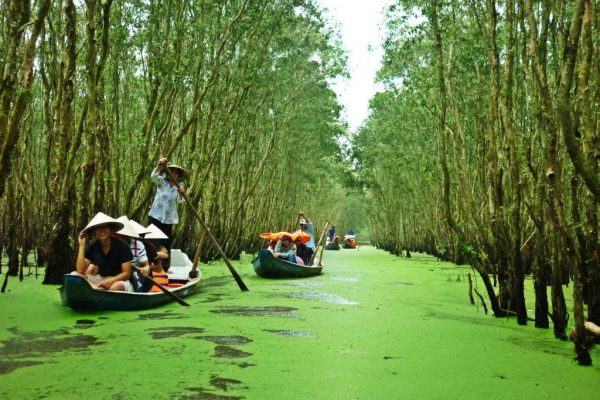
Day boats fill a smaller role again: a few hours on the water as part of a land-based itinerary, most often a floating-village visit on the Tonle Sap or a canal excursion in the delta, with no border crossing and no overnight stay involved at all.
The slow boat: Huay Xai to Luang Prabang
Further up the river in Laos, the two-day slow boat from Huay Xai to Luang Prabang, with an overnight stop in the riverside town of Pakbeng, is one of the most-repeated Mekong journeys there is, and it comes in two very different forms. The public boat costs roughly 430,000 to 500,000 kip per person, around 23 to 24 US dollars, and it’s exactly what it sounds like: a long wooden passenger boat, shared bench seating, no assigned meals, and a straightforward overnight in a basic guesthouse at Pakbeng that you arrange yourself. The premium version, run by a small number of dedicated tour operators, costs around 250 US dollars per person and includes proper seating, meals aboard, a guide, and a stop at the Pak Ou caves partway through that the public boat doesn’t build in as standard.
The difference isn’t really about comfort alone, it’s about what kind of trip you’re on. The public boat is the backpacker route: cheap, a little cramped, entirely dependent on you sorting your own Pakbeng accommodation and onward plans. The premium boat is a guided experience with the logistics handled and a narrower, more curated version of the same river, at roughly ten times the cost. Neither is the wrong choice; they’re simply not the same product, and a traveller expecting premium comfort for public-boat money, or the other way round, is the one who ends up unhappy with either.
Compare the options
| River stretch | Duration | Boat type | Best season |
|---|---|---|---|
| Saigon – Phnom Penh – Siem Reap | 3 to 8 nights | Overnight cruise ship | Nov–Apr; expect a Kampong Cham boarding point Jan–Apr |
| Chau Doc – Phnom Penh | 5 to 6.5 hours | Fast passenger boat | Year-round, one sailing daily each way |
| Tonle Sap floating villages | 2 to 3 hours | Day boat | Nov, when water is high enough to reach the villages easily |
| Huay Xai – Luang Prabang | 2 days, overnight in Pakbeng | Slow boat, public or premium | Nov–Feb, before river levels drop further into the dry season |
What brochures don’t say about water levels
Every cruise brochure on this river shows a fixed itinerary with named stops on named days. What most of them don’t say clearly is that dry-season water levels on the Mekong have been getting lower over recent years, driven mainly by the chain of large dams upstream in China holding back water during the season the lower river relies on it most. The practical result is that boarding points shift, a stop that used to be reachable by a larger vessel becomes a smaller-boat transfer instead, and the itinerary you book eighteen months out is not always the exact itinerary you sail. This applies most to the Cambodian stretch between roughly January and April, and to a lesser extent to the slow boat route in Laos toward the end of the dry season.
None of this is a reason to avoid a river cruise. It’s a reason to book with an operator who tells you this upfront, to ask specifically about boarding points if you’re travelling January through April, and to build a little flexibility into the days immediately before and after your cruise in case a transfer changes. A cruise that adapts to the river it’s actually sailing on is a better sign than one that pretends the water never moves.