Getting to know Hue
Thirteen emperors of the Nguyen dynasty, Vietnam's last ruling house, held their throne in this single city between 1802 and 1945. Their legacy is unusually intact for a monument this old: a fortified enclosure with an inner court once closed to outsiders, plus a scatter of tombs set back among pine trees along the river. UNESCO listed the complex in 1993, and even a half-day covering the enclosure and one or two tombs makes the reasoning obvious.
A note on geography, since this site is built around a different river system: the waterway running through Hue, the Perfume River, has no link to the Mekong at all. It begins in the Truong Son mountains and empties into the South China Sea inside city limits, hundreds of kilometres from the delta and further still from Laos or Cambodia. Hue makes this site's lineup because travellers routing between north and south Vietnam almost always stop here, frequently pairing the trip with a separate leg through the Mekong Delta, not because the two rivers connect in any way.
Food is the other draw worth planning around. Palace chefs once built an intricate cuisine of small, precisely arranged dishes to feed the royal household, and that tradition still shapes the city's kitchens today, running alongside everyday staples like bun bo Hue, a spicy beef and pork noodle soup that takes its name from the city. Pairing a market walk through Dong Ba with a short cooking class is an easy way to taste both traditions in a single afternoon.
Things to see and do
Hue Citadel and the Imperial Enclosure
A walled city within the city, begun in 1805, with the former royal palace and residential quarters inside its inner walls.
Tomb of Tu Duc
A landscaped retreat of pavilions and a small lake, built by the emperor who reigned longer than any other Nguyen ruler and reportedly used it as a getaway well before his death.
Tomb of Khai Dinh
A hillside monument mixing European and Vietnamese styles in concrete and mosaic, the most ornate and the most visually startling of the three main tombs.
Tomb of Minh Mang
Formal, symmetrical grounds arranged around a lake, generally rated the most classically Vietnamese in design of the major royal tombs.
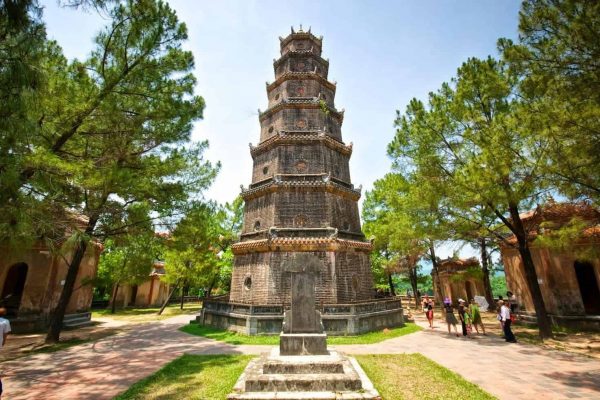
Thien Mu Pagoda
A seven-storey tower above the Perfume River, one of the most recognisable religious buildings in the country and an easy stop by road or boat.
Dong Ba Market
The city’s working market, stacked with dried goods, herbs and the raw ingredients behind Hue’s court and street cooking.
Dragon boat on the Perfume River
An evening cruise built around a live performance of ca Hue, a sung poetry tradition with roots in the royal court, best heard on the water rather than on a stage.
The three tombs above are the ones worth prioritising if time is short, and each was designed to reflect the personality of the emperor buried there rather than to a single template, which is part of why visiting more than one rewards the extra hour.
Hai Van Pass, the coastal mountain road between Hue and Da Nang, is worth building into the itinerary as a stop in its own right rather than something to sit through: a private car with a break at the summit for the view over the coastline is the usual way to do it.
Good to know
| What | Detail |
|---|---|
| Weather pattern | Runs later than the rest of the country: heaviest rain and flood risk from September through December, drier March to August |
| Hai Van Pass to Da Nang | About 2 to 3 hours by road over the pass, one of the country’s better scenic drives |
| Airport | Phu Bai Airport (HUI), a short drive from the city centre |
| Rail | A stop on the Reunification Express, the north-south line linking Hanoi and Ho Chi Minh City |
| Getting around | Taxi, ride-hailing app, cyclo near the citadel, boat for the river tombs and pagoda |
Trips that include Hue
A single overnight in Hue slots comfortably into a route running between the bay in the north and the coast further south. Tell us your travel dates and group size and we can build the imperial enclosure, two royal tombs and a river cruise into a schedule you are already planning.