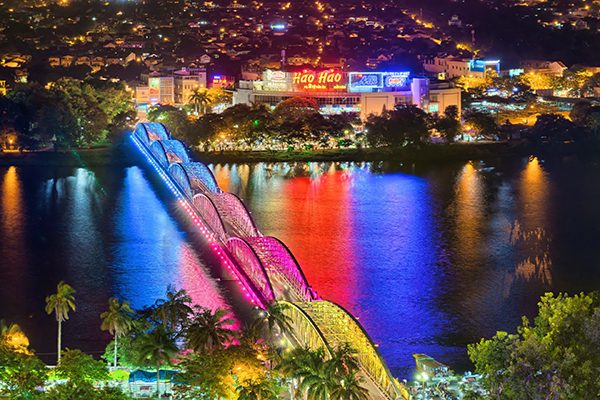
Getting to know Da Nang
Da Nang is central Vietnam’s largest city and its main air gateway, with direct domestic flights to Hanoi and Ho Chi Minh City plus a growing list of international routes. My Khe, the city’s own beach, gives it a resort edge that neither of the country’s two bigger cities can match, and that combination of a working international airport and a proper stretch of sand is the main reason travellers use it as a base rather than a quick transit stop.
For the record, since this is a Mekong-focused site: Da Nang sits on the Han River, which has no connection to the Mekong system and empties into the South China Sea within the city itself. We cover Da Nang because it is the practical hub for central Vietnam legs of longer, north-to-south itineraries, often booked alongside a Mekong Delta stretch further south, not because of any link to the river we specialise in.
Since the July 2025 provincial mergers, Da Nang’s administrative area has grown to take in the whole of the former Quang Nam province, which means Hoi An and the My Son ruins now sit inside Da Nang’s own boundaries rather than a neighbouring province. For a visitor the practical effect is small: both are still reached by the same roads, in the same amount of time, as before.
Things to do in Da Nang
My Khe Beach
A long stretch of city-front sand, once known to American troops as China Beach, calm enough for a swim and close enough to reach from any downtown hotel.
Son Tra Peninsula and Linh Ung Pagoda
A forested headland with a coastal road, monkeys in the tree canopy and a tall seated Buddha statue with sea views from the pagoda grounds.
Marble Mountains
Five limestone hills a short drive south of the centre, riddled with cave shrines and Buddhist sanctuaries carved into the rock.
Dragon Bridge
A steel dragon spanning the Han River that breathes fire and water on weekend nights, one of the city’s more theatrical landmarks.
Museum of Cham Sculpture
The largest collection of Cham stone carving anywhere, a worthwhile stop for anyone interested in the region’s pre-Vietnamese history.
Ba Na Hills and the Golden Bridge
A cable car ride up to a mock French hill town and a walkway held up by two giant stone hands. Worth knowing going in: this is a built theme park, not a natural site, and it draws large crowds; travellers looking for real forest and quiet views are usually better off on Son Tra instead.
Son Tra is the better choice if what you actually want is nature rather than a constructed attraction. The peninsula holds one of Vietnam’s last coastal rainforests, a resident population of red-shanked douc langurs found almost nowhere else, and a loop road with sea views the whole way round.
The Hai Van Pass, the coastal mountain road toward Hue, starts just north of the city and is worth treating as a half-day outing on its own rather than something to drive through on the way to somewhere else.
Good to know
| What | Detail |
|---|---|
| Weather pattern | February to May is dry and warm; June to August is hot and busy on the beach; September to December brings the wet season and occasional storm risk |
| To Hoi An | About 30 km, 45 minutes by road, no river or ferry crossing needed |
| To Hue | About 2 to 3 hours by road over the Hai Van Pass, or a short domestic flight |
| Airport | Da Nang International Airport (DAD), close to the city centre |
| Administrative shape | Since July 2025, Da Nang’s city limits have absorbed the former Quang Nam province, including Hoi An and My Son |
Trips that include Da Nang
None of these routes are fixed. A Da Nang stop can shift earlier or later relative to Hue on one side and Hoi An on the other, or extend north to fold in Hanoi and the bay. Share your travel dates and how many are in your group, and we will draft a day-by-day schedule with hotel options to match.