Getting to know Ho Chi Minh City
For international arrivals bound for the Mekong region, Tan Son Nhat is the airport nearly everyone lands at first: it handles more international traffic than any other airport in the country, and it sits close enough to District 1 that a hotel check-in can happen within the hour. From there, the road toward the delta begins almost immediately. My Tho lies roughly 70 km to the southwest, an hour or so by car, and the expressway now carries traffic on to Can Tho in about two hours rather than the half-day drive that route used to demand. That combination, a major airport paired with fast roads south, is why so many delta itineraries open and close here rather than in any other city.
The city itself changed shape on 1 July 2025, when a nationwide round of provincial mergers folded Binh Duong and Ba Ria-Vung Tau into what was formerly known as Ho Chi Minh City proper. The combined municipality now covers roughly 6,772 square kilometres and holds close to 14 million residents, which makes it by far the largest urban administrative area in the country. One practical effect worth knowing: the beaches and port town of Vung Tau, once a separate coastal province, now sit inside the same city boundary as downtown District 1, even though the drive between the two still takes about two hours.
Down at street level, the older parts of downtown still carry the layout and the pace that earned the district its long-running nickname of Saigon, a name locals use more often than the official one. Colonial-era buildings stand a short walk from glass office towers, and the Chinese quarter of Cho Lon keeps a rhythm of its own a few kilometres to the west, busy with wholesale trade rather than tourist shops. None of this is a museum piece; it is a working city of well over ten million people, and the traffic, the food stalls and the constant motorbike hum are as much a part of the visit as any single landmark.
Things to see and do
Cu Chi Tunnels
A wartime tunnel network with two visitor sites: Ben Dược, about 70 km from downtown, and Ben Dinh, the closer option at roughly 50 km.
Independence Palace
The former presidential residence at 135 Nam Ky Khoi Nghia, sold as tickets from 8:00 to 15:30; entry is 40,000 dong, or 65,000 dong for the combined ticket with the exhibition wing.
War Remnants Museum
At 28 Vo Van Tan, open 7:30 to 17:30 daily, admission 40,000 dong with free entry for children under six.
Saigon Central Post Office
A working post office in a nineteenth-century French building opposite the cathedral, free to walk through.
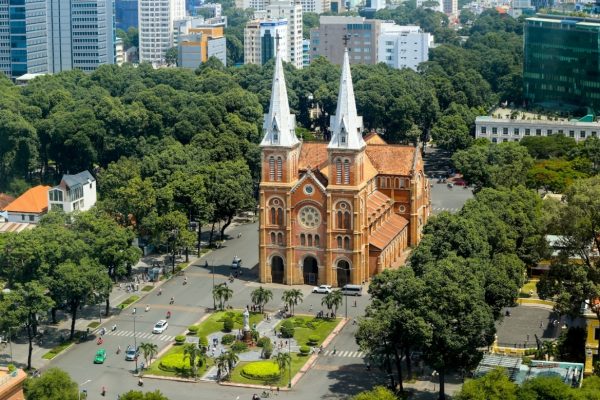
Notre-Dame Cathedral
Under long-term restoration since 2017; two gilded crosses were fixed to the steel spires on 19 March 2026, but the full project will not be finished this decade, so plan on viewing the exterior only.
Ben Thanh Market
The covered central market for produce, textiles and street food, one of the oldest fixtures of downtown commerce.
Nguyen Hue walking street
A pedestrian boulevard running from the old city hall down toward the river, lively in the evening and on weekends.
Cho Lon
The city’s historic Chinese district, worth a wander for its temples, herbal shops and wholesale markets away from the main tourist strip.
Several of these sites cluster tightly enough around District 1 that a single day on foot can cover the cathedral, the post office, Ben Thanh Market and Nguyen Hue with time to spare, leaving the Cu Chi Tunnels or a Mekong Delta excursion as a separate half or full day out of the city. Cho Lon rewards a slower visit and pairs naturally with a late lunch, since most of its interest lies in the everyday trade rather than a single ticketed sight.
Good to know
| What | Detail |
|---|---|
| Airport | Tan Son Nhat International (SGN), Vietnam’s busiest gateway for international flights |
| Getting to the delta | My Tho about 70 km by road; Can Tho about 2 hours via the expressway |
| Metro Line 1 | Ben Thanh to Suoi Tien, now operating; single fares 7,000-20,000 dong, a day pass 40,000 dong, a 3-day pass 90,000 dong |
| Saigon Waterbus | Bach Dang to Linh Dong, about 11 km with 5 stops; 15,000 dong one way or 30,000 dong return; runs 7:00-21:00 weekdays and to 23:00 on weekends |
| City size since July 2025 | About 6,772 sq km and roughly 14 million people, after merging with Binh Duong and Ba Ria-Vung Tau |
| Notre-Dame Cathedral | Restoration ongoing since 2017, exterior viewing only, no completion date before the end of this decade |
Trips that include Ho Chi Minh City
Any of these can be shortened, lengthened or reordered around your own flight dates, and a Mekong Delta extension can be dropped into almost any of them without disturbing the rest of the plan.