Trip overview
Where our seven-day route treats Angkor as the destination and moves through everything before it quickly, this one runs the other way. Two nights in Ho Chi Minh City come first, enough time for the tunnels at Cu Chi and the museums that explain the war rather than skate past it. A day threading through flower villages and river islets carries you toward the Cambodian border, and once you’re across, Phnom Penh gets two full days instead of one rushed afternoon. Siem Reap and Angkor close the trip out, but by then you’ve already had a week of cities and rivers behind you.
The route crosses a stretch of Vietnam reshaped by the 2025 provincial merger: Sa Dec now falls within an enlarged Dong Thap province centred on My Tho, and Chau Doc sits inside An Giang, administered from Rach Gia rather than the more commonly cited Long Xuyen. None of that changes the flower fields or the river crossing itself, only the names on the map. In Cambodia, Phnom Penh’s riverfront and its harder history get a full two days before the road or a short flight carries you to Siem Reap for the temples.
Trip highlights
- Cu Chi’s tunnels and Ho Chi Minh City’s war museums, given two unhurried days
- Sa Dec’s flower nurseries and a river-islet stop on the way to the Cambodian border
- A fast boat crossing the river frontier from Chau Doc to Phnom Penh
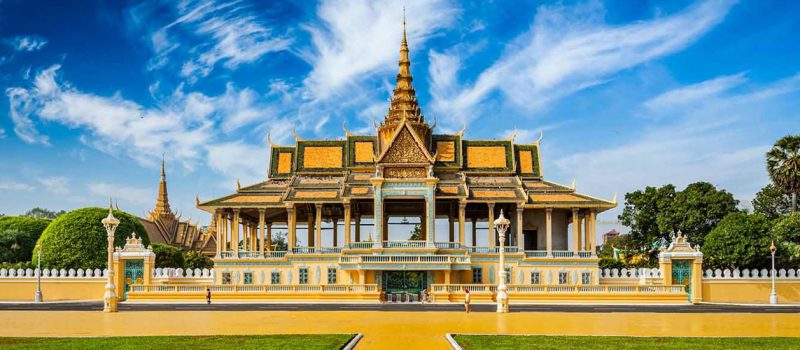
- Two full days in Phnom Penh: the Royal Palace, the National Museum, Tuol Sleng and Choeung Ek
- Sisowath Quay and the Chaktomuk confluence, where three rivers meet in front of the capital
- Angkor Wat, Bayon and Ta Prohm, plus a Tonle Sap floating village away from the tour-bus crowds
Your day-by-day itinerary
Day 1: Arrive Ho Chi Minh City, Cu Chi Tunnels (about 70 km, half day)
Depending on your arrival time, the afternoon heads out to the tunnel network at Cu Chi, where guides talk through how an underground war was fought and lived, not just how the tunnels were dug. Back in the city by evening, with time to walk around your hotel district before dinner.
Day 2: Ho Chi Minh City: Independence Palace and the War Remnants Museum
A full city day. The morning covers Independence Palace, preserved as it stood on the day Saigon fell, and the War Remnants Museum, whose exhibits are direct and often difficult rather than sanitised. In the afternoon there’s a walk past Notre-Dame Cathedral, currently mid-way through a major restoration that started in 2017 and won’t be finished by the original 2027 target, and on to Ben Thanh Market for a first taste of the city’s street life.
Day 3: Ho Chi Minh City to Chau Doc via Sa Dec (about 6–7 hours total by road)
The drive west stops mid-morning in Sa Dec, the delta’s largest flower-growing town, at its most spectacular in the run-up to Lunar New Year but worth a look at any time of year for its nurseries and its old riverside houses, including the one at the centre of Marguerite Duras’s novel The Lover. From there it’s on to Chau Doc, arriving by early evening with time for a walk along the river before dinner.
Day 4: Chau Doc to Phnom Penh by river (about 5–6.5 hours including border formalities)
An early start: the boat leaves Chau Doc around 7:00 to 7:30 am and reaches Phnom Penh by roughly 1:00 to 1:30 pm, crossing at Vinh Xuong on the Vietnamese side and Kaam Samnor on the Cambodian side along the way. The afternoon is yours to walk Sisowath Quay and take in the Chaktomuk confluence, where the Mekong, the Tonle Sap and the Bassac meet in front of the city.
Day 5: Phnom Penh: the Royal Palace and the National Museum
A full day inside the capital’s older core. The Royal Palace grounds and the Silver Pagoda take the morning, and the National Museum’s collection of Khmer sculpture the early afternoon, both within easy walking distance of the river. Evening is free to return to Sisowath Quay, busier now with the dinner crowd than it was on your arrival.
Day 6: Phnom Penh: Tuol Sleng and Choeung Ek
A harder day, and a necessary one. Tuol Sleng, the former high school turned into the Khmer Rouge’s S-21 interrogation centre, takes the morning, followed by Choeung Ek, one of the killing fields on the city’s outskirts, in the early afternoon. Neither site is easy going, but skipping them would leave a false picture of the country you’re travelling through. The rest of the afternoon is left open, deliberately, to decompress before dinner.
Day 7: Phnom Penh to Siem Reap (by air or by road, about 320 km)
A short domestic flight or a road transfer, depending on your preference and the day’s schedule, brings you to Siem Reap by the afternoon. With Angkor waiting for tomorrow, the rest of the day is unstructured: a walk through the Old Market quarter, or simply resting after a full week.
Day 8: Angkor and a Tonle Sap floating village, departure
A single, focused day at Angkor Archaeological Park, covering Angkor Wat, the faces of Bayon and the tree-tangled ruins of Ta Prohm; a one-day Angkor Pass costs 37 USD (2026 price), sold at the Angkor Ticket Office between 5:00 am and 5:30 pm or online in advance. If timing allows before your flight, a stop at Kampong Khleang, about 55 km from Siem Reap and generally considered the least touristed of the Tonle Sap floating villages, rather than the closer but more commercialised Chong Khneas around 15 km out. From there it’s on to Siem Reap–Angkor International Airport, about 50 km from town, for departure.
What’s included
- Hotels in the class you choose, twin or double occupancy, with breakfast each morning, or an equivalent property if the one named is full.
- All meals written into the day-by-day programme below.
- A private air-conditioned vehicle for every transfer and excursion in the programme.
- An English-speaking local guide at each stop on the route.
- Every boat trip, river crossing and cruise named in the itinerary.
- Entrance fees for the sites listed in the programme.
- Drinking water in the vehicle and on boat days.
- Government tax and service charge.
Not included
- International and domestic flights, and rail tickets.
- Visas, and any fee collected at a border post.
- Travel insurance.
- Meals and drinks that are not written into the programme.
- Personal spending such as laundry, phone calls, minibar, souvenirs and watersports.
- Early check-in, late check-out and room upgrades.
- Anything added on the day at your request outside the printed programme.
- Gratuities for your guide and driver.
- Costs arising from weather, flooding, road closures or other events beyond our control.
- Bank transfer charges.
Booking this trip
- Days
- 8 days / 7 nights
Sending this does not charge you. We hold the space and confirm within 24 hours.
Border rules, currency and what to expect on both sides of the river are covered on our [travel information for the Mekong countries](mekong/travel-information) page.
Send us your travel dates and how many people are traveling, and we’ll check boat and flight availability and reply with a plan and a quote by email.