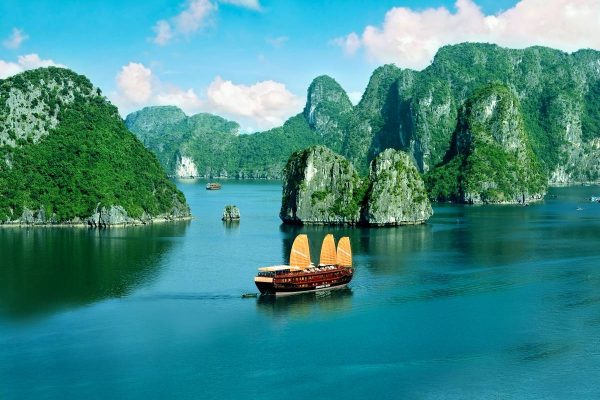
Getting to know Ha Long Bay
Worth stating clearly: this is a coastal bay in the Gulf of Tonkin, far to the north, and it has no connection to the Mekong River that anchors the rest of this site. It earns a page here for a simple reason, that a great many travellers building a longer route through Vietnam pair a Mekong Delta leg in the south with a swing through the north, and Ha Long Bay is consistently the piece they add. Roughly 1,600 limestone islands and islets rise out of the bay’s water, most of them uninhabited, and UNESCO listed the whole formation as a World Heritage Site back in 1994.
Almost everyone experiences the bay from the deck or the cabin of a cruise boat rather than from any single shore-based viewpoint, since that is the only practical way to move among the scattered islands, caves and hidden lagoons that make the place worth visiting in the first place. The expressway from Hanoi covers the distance in about two and a half hours, which is short enough that a one-night cruise still leaves useful time on the water rather than eating the whole trip in transit.
The bay’s central corridor, the stretch nearest the main port and the one most cruise itineraries default to, draws by far the heaviest boat traffic, particularly during Vietnamese holiday periods and the peak months in the middle of the year. Anyone who has pictured a quiet, empty seascape should know that the central route rarely delivers that on its own; it takes a specific choice of itinerary, described below, to get there.
Things to see and do
Overnight cruise
The standard way to see the bay, in cabins that span everything from a basic wooden boat to a higher-end vessel with a private balcony.
Sung Sot Cave
The bay’s largest and most visited cave system, with chambers tall and wide enough to hold large groups at once.
Kayaking among the karsts
Most cruise itineraries build in a kayak session through calmer channels between the limestone formations.
Floating fishing village
A cluster of houses built directly on the water, reached by small boat from the cruise vessel.
Lan Ha Bay
A quieter southern extension of the same limestone formation, with noticeably less boat traffic than the central route.
Bai Tu Long Bay
An area to the northeast that sees far fewer cruise boats than the main bay, another route for travellers seeking a calmer pace.
Cat Ba Island
The largest island in the bay, holding a national park and serving as a land base for travellers who want a night off the boat.
If a crowded central bay does not appeal, ask specifically for an operator running the Lan Ha Bay or Bai Tu Long routes rather than the standard central circuit; both cover comparable scenery with a fraction of the boat traffic. Two nights on the water, rather than one, is what buys the time to add Cat Ba island or a second cave system without rushing either.
Good to know
| What | Detail |
|---|---|
| From Hanoi | About 2.5 hours by expressway to the main cruise ports |
| Cruise permits and weather | Sailings depend on a daily weather clearance from the port authority; departures can be delayed or cancelled at short notice in poor conditions |
| Summer risk | Typhoons are possible in the middle of the year and can force last-minute cancellations |
| Winter conditions | Fog is common in the cooler months and can occasionally shorten or reroute a sailing |
| Boat classes | Range from simple wooden day-boats to higher-end cabin cruisers with private balconies |
| Motion sickness | The central bay is largely sheltered and calm, so seasickness is uncommon outside of storm weather |
Trips that include Ha Long Bay
One night or two, central bay or the quieter Lan Ha route, every one of these can be adjusted to fit your dates. Tell us when you would like to travel and how many people are coming, and we will map out cruise options that match.