Getting to know Sa Pa
A word of warning before anything else: the town of Sa Pa itself has been built up hard over the past fifteen years, and the quiet hill station of old postcards is mostly gone. Hotel towers now crowd the slopes above the valley, and on a busy weekend the main streets can feel like any other Vietnamese tourist town, minus the sea view. None of that is a reason to skip the region. It is a reason to spend as little time as possible in the town centre and get straight down into the valley.
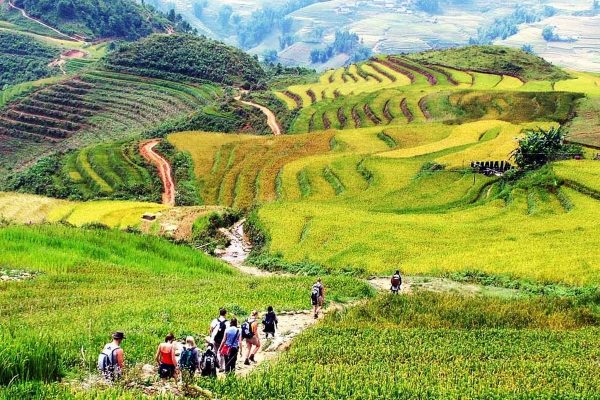
What still holds is the landscape below it: the Muong Hoa Valley, its terraces cut by hand generations ago and still worked the same way, and the string of villages tucked among them, home to H’mong, red Dao and Tay families. Walk an hour or two out of town on any of the paths through Lao Chai, Ta Van or Y Linh Ho and the crowds thin fast, replaced by buffalo tracks, running irrigation channels and the sound of looms in the houses along the way. Spend a night in one of the family-run homestays here rather than a hotel back in town and the difference in what you actually experience is considerable.
Above it all sits Fansipan, the highest point in Indochina at 3,143 metres, reachable now by cable car in about twenty minutes rather than the two- or three-day climb it used to demand. On a clear morning the ride alone is worth the ticket price, though cloud cover at altitude can just as easily blank out the view. Further out, Bac Ha holds a Sunday market that draws Flower H’mong traders from the surrounding hills, still a working market rather than a staged event, and worth the extra drive for travellers with a spare day.
Things to see and do
Muong Hoa Valley trek
Terraced rice paddies stacked along the valley floor, walked on paths that link village to village.
Lao Chai and Ta Van villages
H’mong and Dao settlements a few hours’ walk from town, with family homestays for those staying overnight.
Fansipan cable car
A twenty-minute ride to the summit of the highest peak in Indochina, weather permitting.
Bac Ha Sunday market
A genuine weekly trading market for Flower H’mong communities, roughly two hours’ drive from town.
Cat Cat village
The closest H’mong village to Sa Pa, an easy walk for anyone short on time.
Silver Waterfall and Tram Ton Pass
A roadside waterfall stop on the drive toward the pass, usually combined with the Fansipan trip.
Sa Pa night market
Grilled food stalls and handicraft stands that fill the square most evenings.
Guides matter more here than in most of Vietnam. The paths through the valley are not signposted for outsiders, several stream crossings depend on the season, and a local guide from one of the villages, rather than an outside operator, keeps the income where the walking actually happens.
One point worth being direct about: Sa Pa sits in the Red River basin, in the far north of Vietnam, and has nothing to do with the Mekong. It has a place on this site because of how often it turns up on a longer Vietnam route, not because of the river the rest of this website is built around.
Good to know
| What | Detail |
|---|---|
| Getting there | About 5-6 hours by road from Hanoi via the Noi Bai-Lao Cai expressway; no rail or air link runs directly to the town |
| Trekking difficulty | Paths range from flat valley walks to steeper multi-hour routes; a moderate level of fitness covers most itineraries |
| Footwear and rain gear | Trails turn to mud fast after rain; sturdy shoes with grip and a light rain layer matter more than anything else you pack |
| Local guides | Hired through the villages themselves rather than only through a hotel desk, which puts guiding income directly into the community walked through |
| Weather by season | Cold with occasional frost from December to February; frequent low cloud and mist through the summer months |
| Best rice-terrace views | Golden, ready-to-harvest rice around September; flooded, mirror-like terraces before transplanting in May and June |
Trips that include Sa Pa
Sa Pa can also be added to a shorter Hanoi stay or moved to either end of a longer itinerary, since the drive from the capital works equally well as an opening leg or a final one. Tell us your dates and how many nights you can spare and we will fit it around the rest of your route.