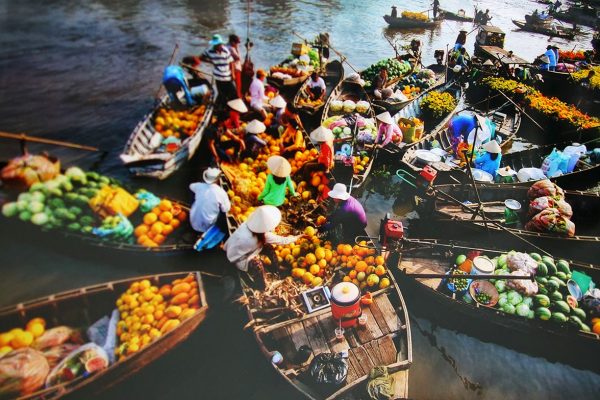
Trip overview
Can Tho is the largest city in the delta and, since the 2025 provincial merger, the seat of a much larger municipality that now also takes in Soc Trang and Hau Giang. The expressway from Saigon gets you there in around two hours, a trip that used to take three and a half to four hours on the old National Highway 1, which changes what this itinerary can fit into three days. You arrive with an afternoon still ahead of you, spend it around Ninh Kieu wharf, and are in position for an early start on the market the next morning.
We need to say plainly what Cai Rang is now, because a lot of marketing still shows photographs from a busier decade. Cai Rang once had something like 600 trading boats; today it runs at around 100, and on many mornings tourist boats outnumber the wholesalers selling produce off the bow. The reason is straightforward: roads and the new expressway now move vegetables and fruit out of the delta faster than a boat can, so wholesalers who used to gather on the river increasingly sell from trucks at the farm gate instead. None of that makes the market not worth seeing. It makes timing the whole trip. Trading is heaviest between roughly 5 and 7am and thins out fast after 8, so we leave the wharf before sunrise rather than after breakfast, which is when most day tours from Saigon show up to find the market already quiet.
Trip highlights
- A pre-dawn departure from Ninh Kieu wharf for Cai Rang, timed to the 5 to 7am window when trading boats are still on the water
- An honest look at a working river market in decline, not a staged photo stop
- Binh Thuy ancient house, a century-old French-Vietnamese building used as a filming location for The Lover
- A short boat crossing to Con Son islet for fish-feeding ponds, an orchard walk and a folk-cake demonstration
- Live don ca tai tu music heard where it is actually played, not performed for a tour bus
- Two hours each way on the Saigon–Can Tho expressway instead of the old four-hour road
Your day-by-day itinerary
Day 1: Saigon to Can Tho by expressway (about 2 hours), Ninh Kieu wharf
Your guide and driver collect you in Saigon and take the expressway south, a run of around two hours that has cut what used to be a half-day drive down considerably. You check into your hotel and spend the afternoon around Ninh Kieu, the riverside promenade that is the centre of Can Tho's tourist district, with its walking bridge and evening night market. It is an easy first afternoon, and deliberately so: you are going to be up before dawn tomorrow.
Day 2: Cai Rang floating market at dawn (boat, about 30 minutes each way), Binh Thuy ancient house, Con Son islet (boat, 10-15 minutes)
You leave the wharf while it is still dark, reaching Cai Rang, about 6 kilometres downriver and roughly 30 minutes by boat, in time for the market's busiest hour. What you will see is a working river trade that has shrunk to around 100 boats from a peak of 600, with tourist craft now often outnumbering the wholesalers who still hang a sample of their cargo from a tall pole so buyers can spot it from a distance. By 8am the market is visibly thinning, which is your cue to move on. From there you visit Binh Thuy ancient house, a French-Vietnamese building more than a century old that appeared in the film The Lover, then take a short 10 to 15 minute boat crossing to Con Son islet, where a local family shows you fish-feeding ponds, walks you through an orchard plot and demonstrates a round of southern folk cakes, usually with a short set of don ca tai tu music in the garden.
Day 3: Free morning in Can Tho, drive back to Saigon by expressway (about 2 hours)
A slower final morning, with time to walk Ninh Kieu again in daylight or rest at the hotel before checkout. You return to Saigon on the expressway, arriving in the early afternoon.
What’s included
- Hotels in the class you choose, twin or double occupancy, with breakfast each morning, or an equivalent property if the one named is full.
- All meals written into the day-by-day programme below.
- A private air-conditioned vehicle for every transfer and excursion in the programme.
- An English-speaking local guide at each stop on the route.
- Every boat trip, river crossing and cruise named in the itinerary.
- Entrance fees for the sites listed in the programme.
- Drinking water in the vehicle and on boat days.
- Government tax and service charge.
Not included
- International and domestic flights, and rail tickets.
- Visas, and any fee collected at a border post.
- Travel insurance.
- Meals and drinks that are not written into the programme.
- Personal spending such as laundry, phone calls, minibar, souvenirs and watersports.
- Early check-in, late check-out and room upgrades.
- Anything added on the day at your request outside the printed programme.
- Gratuities for your guide and driver.
- Costs arising from weather, flooding, road closures or other events beyond our control.
- Bank transfer charges.
Booking this trip
- Days
- 3 days / 2 nights
Sending this does not charge you. We hold the space and confirm within 24 hours.
For visa rules, payment terms and what to expect on the ground before you travel, see [Vietnam travel information](vietnam/travel-information).
Send us your travel dates and the number of travellers and we will confirm your hotel and hold the departure for you.