Trip overview
Chiang Mai holds three of the four nights here, beginning with a half-day stop at Wat Phra That Doi Suthep on its forested hill above the city, followed by a visit to the Doi Pui hill-tribe market for textiles and silverwork. The remaining day belongs entirely to Chiang Rai, reached by a long drive north: Wat Rong Khun in blinding white, Wat Rong Suea Ten in blue and gold, the timber-and-bone art compound of Baan Dam, and a final look across the water at the Golden Triangle.
One fact worth stating plainly: Chiang Mai itself has nothing to do with the Mekong. It sits on the Ping River, part of the separate Chao Phraya watershed that drains south toward Bangkok, not the river this site is organised around. We keep this trip on offer regardless, because Chiang Mai, paired with Chiang Rai, forms the natural land route north toward the river proper, at Chiang Saen, at the Golden Triangle confluence, and at the Chiang Khong crossing to Huay Xai over the Fourth Thai-Lao Friendship Bridge. Travellers who want to keep going once the Mekong finally appears can follow this trip with our [Chiang Rai and the Golden Triangle guide](thailand/chiang-rai-and-the-golden-triangle), continue by river into Laos on the [slow boat from Huay Xai to Luang Prabang](laos/tours/7d6n-slow-boat-huay-xai-to-luang-prabang), or go the full distance on [Golden Triangle to the Nine Dragons](mekong/tours/14d13n-golden-triangle-to-the-nine-dragons), which follows the river from here through Laos and Cambodia to Vietnam’s delta.
Trip highlights
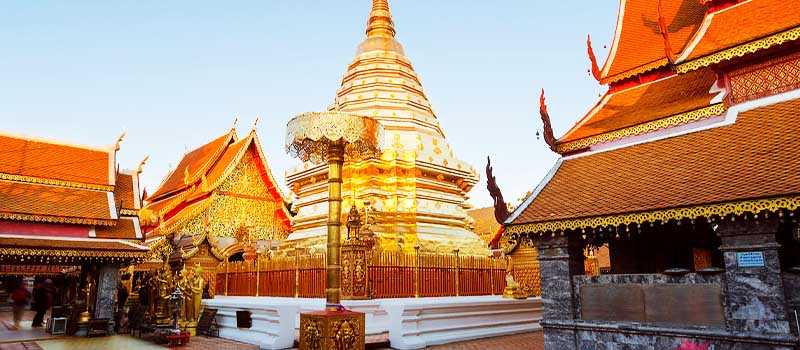
- Wat Phra That Doi Suthep, a gilded hilltop temple with views back over the Chiang Mai valley
- Handwoven textiles and silverwork at the Doi Pui hill-tribe market
- Wat Rong Khun in dazzling white and Wat Rong Suea Ten in blue and gold, both in Chiang Rai
- Baan Dam, an artist’s compound built from dark timber, bone and horn
- The Golden Triangle viewpoint, with Chiang Saen and the Chiang Khong border crossing close by
Your day-by-day itinerary
Day 1: Touch Down in Chiang Mai
A transfer from Chiang Mai International Airport brings you into your old-town hotel, where the trip properly begins. The city sits inside a ring of mountains, at noticeably higher altitude than Bangkok, and its centre, bounded by a moat and stretches of a centuries-old wall, holds a denser cluster of temples than almost anywhere else in the north. Evenings here run cooler than on the coast, and this first one is left free to settle in.
Day 2: Doi Suthep Temple and the Doi Pui Hill-Tribe Market
The morning climbs to Wat Phra That Doi Suthep, one of the north’s most sacred sites, where a gilded chedi, resident monks and a naga-flanked staircase of more than three hundred steps (or a funicular, for those who would rather skip it) lead up to sweeping views over the valley. The morning continues at the nearby Doi Pui market, where Hmong vendors sell handwoven textiles, silver jewellery and produce grown in the surrounding hills.
Day 3: Full Day North to Chiang Rai and the Golden Triangle
The drive climbs through forest and farmland before reaching Chiang Rai, where Wat Rong Khun, widely known as the White Temple, earns the longest stop here, its all-white, mirror-inlaid facade drawing every camera in sight. Next comes Wat Rong Suea Ten, called the Blue Temple, in a deep indigo and gold that plays almost as its opposite, and Baan Dam, better known as the Black House, closes the set with a compound of dark timber buildings filled with bone, horn and animal-hide artwork rather than anything conventionally religious.
The itinerary this trip is based on once routed through a so-called long-neck Karen village at this point in the day; we have dropped that stop. These displays place Kayan women, many of them displaced from Myanmar, on show for tourist photographs in return for a small commission, and rights groups have criticised the practice for years as a form of human zoo tourism. We send you to the Golden Triangle viewpoint instead, the point where Laos, Myanmar and Thailand edge up against each other across the water, with Chiang Saen’s old river port and the Chiang Khong crossing to Laos sitting a short drive further on, genuinely part of the Mekong story rather than a staged one.
Day 4: Departing from Chiang Mai
Checking out leads straight into a transfer to the airport for your onward flight. If the Golden Triangle left you wanting more of the river rather than less, this is also the natural point to keep travelling instead of turning back toward the coast, deeper into Chiang Rai or on by land into Laos.
What’s included
- Hotels in the class you choose, twin or double occupancy, with breakfast each morning, or an equivalent property if the one named is full.
- All meals written into the day-by-day programme below.
- A private air-conditioned vehicle for every transfer and excursion in the programme.
- An English-speaking local guide at each stop on the route.
- Every boat trip, river crossing and cruise named in the itinerary.
- Entrance fees for the sites listed in the programme.
- Drinking water in the vehicle and on boat days.
- Government tax and service charge.
Not included
- International and domestic flights, and rail tickets.
- Visas, and any fee collected at a border post.
- Travel insurance.
- Meals and drinks that are not written into the programme.
- Personal spending such as laundry, phone calls, minibar, souvenirs and watersports.
- Early check-in, late check-out and room upgrades.
- Anything added on the day at your request outside the printed programme.
- Gratuities for your guide and driver.
- Costs arising from weather, flooding, road closures or other events beyond our control.
- Bank transfer charges.
Booking this trip
- Days
- 4 days / 3 nights
Sending this does not charge you. We hold the space and confirm within 24 hours.
For visas, payment terms and what to expect on arrival, see [Thailand travel information](thailand/travel-information).
Let us know when you would like to travel, how many people are in your group and which hotel grade you prefer; we will check dates and come back with a written quote by email.