Getting to know Chiang Rai and the Golden Triangle
A lot of travel writing lumps Chiang Mai and Chiang Rai together under a vague label of northern Thailand and the Mekong, and that framing is wrong on the geography. Chiang Mai sits on the Ping River, part of the separate Chao Phraya river system that drains south to Bangkok; the Mekong never comes near it. Chiang Rai province is different. Its northern edge runs along the Mekong itself, through the river towns of Chiang Saen and Chiang Khong and the confluence point known as the Golden Triangle, where Thailand, Laos and Myanmar meet at a bend in the river. If a website advertises a Mekong tour based in Chiang Mai, that claim does not hold up; this stretch, further north and east, is the one that does.
Chiang Saen was a river port of real historical weight, a trading town on the Mekong with brick temple ruins still standing from that era, and it makes a natural stop on the way to the confluence itself at Sop Ruak, where the three national borders meet on the water and a small cluster of viewpoints and museums looks out over the junction. Continue along the river and the road reaches Chiang Khong, a low-key border town best known today as the departure point for the Fourth Thai-Lao Friendship Bridge into Huay Xai, and from there onward by slow boat to Luang Prabang.
Chiang Rai city itself sits a little inland from the river and supplies the region’s other reason to visit: a set of contemporary temple art installations built within living memory rather than centuries ago, alongside the region’s more familiar hill-country scenery.
Things to see and do
Sop Ruak, the Golden Triangle
The point where the borders of Thailand, Laos and Myanmar meet at the Mekong, with viewpoints and small museums on the river.
Chiang Saen
An old Mekong river port town with brick temple ruins from its trading past, a short drive from Sop Ruak.
Chiang Khong
A border town on the river, home to the Fourth Thai-Lao Friendship Bridge and the usual departure point for the slow boat to Luang Prabang.
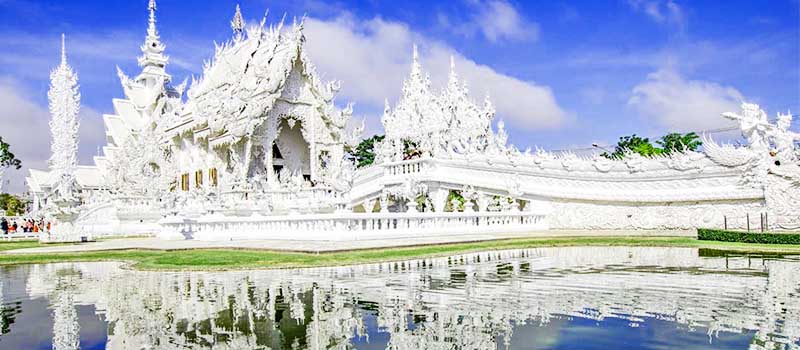
Wat Rong Khun, the White Temple
A contemporary Buddhist temple built almost entirely in white and mirrored glass, one of Thailand’s most photographed modern buildings.
Wat Rong Suea Ten, the Blue Temple
A vivid blue-and-gold temple in Chiang Rai city, a newer counterpart to the White Temple.
Baan Dam, the Black House
An artist’s compound of dark timber buildings filled with bone, horn and animal-skin artwork, an unsettling counterpoint to the two temples.
Most of these sites sit within an hour or two of each other, which makes it possible to work through the river towns on one day and Chiang Rai’s temple art on another without long transfers between them.
Good to know
| What | Detail |
|---|---|
| Chiang Mai and the Mekong | Chiang Mai sits on the Ping River, part of the Chao Phraya basin, not the Mekong; Chiang Rai’s river towns are the genuine Mekong stretch of Thailand |
| Fourth Thai-Lao Friendship Bridge | At Chiang Khong, the standard crossing point to Huay Xai in Laos and on to the slow boat for Luang Prabang |
| Thailand-Cambodia land border | Closed in stages since 2025 and still closed as of late August 2026, with no confirmed reopening date |
| Connecting to Cambodia | By air only for now, between Bangkok and Phnom Penh or Siem Reap; confirm current status close to your travel date |
| Thailand visa exemption | Cut from 60 to 30 days, effective 15 September 2026 |
| Best season | November to February, dry and cool; expect haze from agricultural burning roughly February to April |
Trips that include Chiang Rai and the Golden Triangle
This region also works well as a standalone add-on before or after a Laos river trip, given how directly Chiang Khong connects to the slow boat route into Luang Prabang. Tell us your dates and whether Laos is part of the plan, and we will route it accordingly.