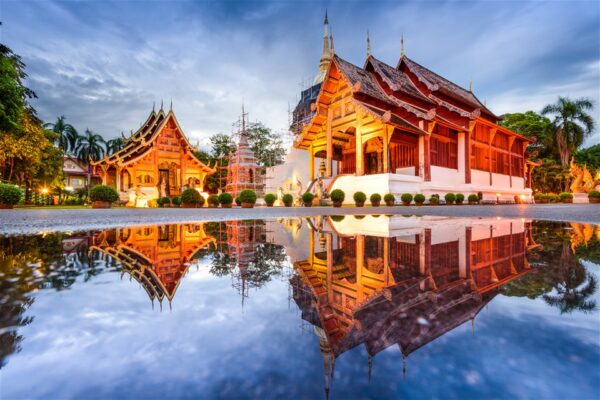
Getting to know Chiang Mai
Chiang Mai is northern Thailand’s largest city, its historic core kept within a moat and a set of defensive walls that have stood for more than seven centuries. It sits at meaningfully higher altitude than Bangkok or the coast, which keeps temperatures noticeably lower, especially between November and February, when a morning spent wandering the temple-filled centre is genuinely pleasant rather than something to push through.
On this site, Chiang Mai serves one specific role: a comfortable, well-connected stop on the route north toward Chiang Rai and the genuine Mekong stretch of Thailand. It is not itself a river town in the sense that matters to us. The temples, the market, the sanctuary and the cooking class here are worth two or three nights on their own merits, and they also happen to sit conveniently between Bangkok and the Golden Triangle.
Most visitors start at Wat Phra That Doi Suthep, on a hill above the city, then spend a second stretch inside the moat itself, where Wat Chedi Luang and Wat Phra Singh anchor a dense cluster of Lanna-style temples within easy walking distance of one another.
Things to see and do
Doi Suthep
A golden hilltop temple with sweeping views back over the city, one of the north’s most recognisable landmarks.
The old walled city and its Lanna temples
Wat Chedi Luang and Wat Phra Singh sit within the moat, along with dozens of smaller temples worth a slow wander.
The night market
Stalls of local crafts, textiles and street food filling several streets of the old town after dark.
An ethical elephant sanctuary
Feeding, bathing and observing elephants at close range, with no riding and no circus-style performance on offer or on the itinerary.
A Thai cooking class
A hands-on half-day introduction to northern Thai dishes, usually starting with a market visit.
Doi Inthanon
Thailand’s highest point, a day trip out for waterfalls, cooler forest air and hill-tribe villages.
Good to know
| What | Detail |
|---|---|
| The river question | The Ping River runs through Chiang Mai; it belongs to the Chao Phraya basin, not the Mekong |
| Best season | November to February, coolest; hot March to May; rain generally June to October |
| Getting there | Domestic flight from Bangkok, about 1 hour 10 minutes; overland options exist but take considerably longer |
| Currency | Thai Baht (THB) |
| Elephant tourism | We book sanctuaries only; riding and performance shows are not part of any itinerary we run |
Trips that include Chiang Mai
A Chiang Mai stay pairs naturally with a push onward to Chiang Rai and the Golden Triangle, where the river genuinely enters the picture. Tell us how many nights you want in each place and we will build the route around it.